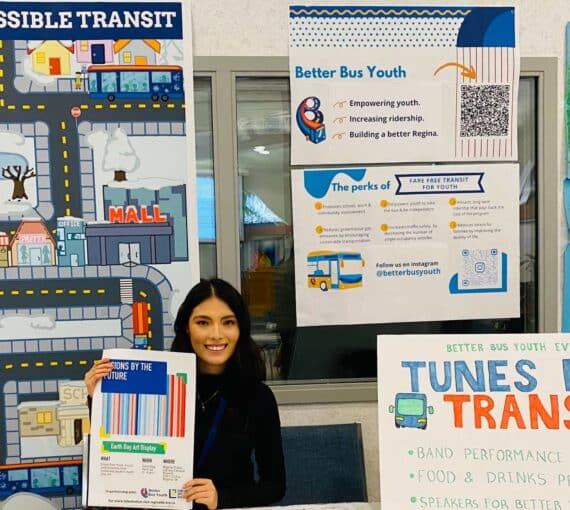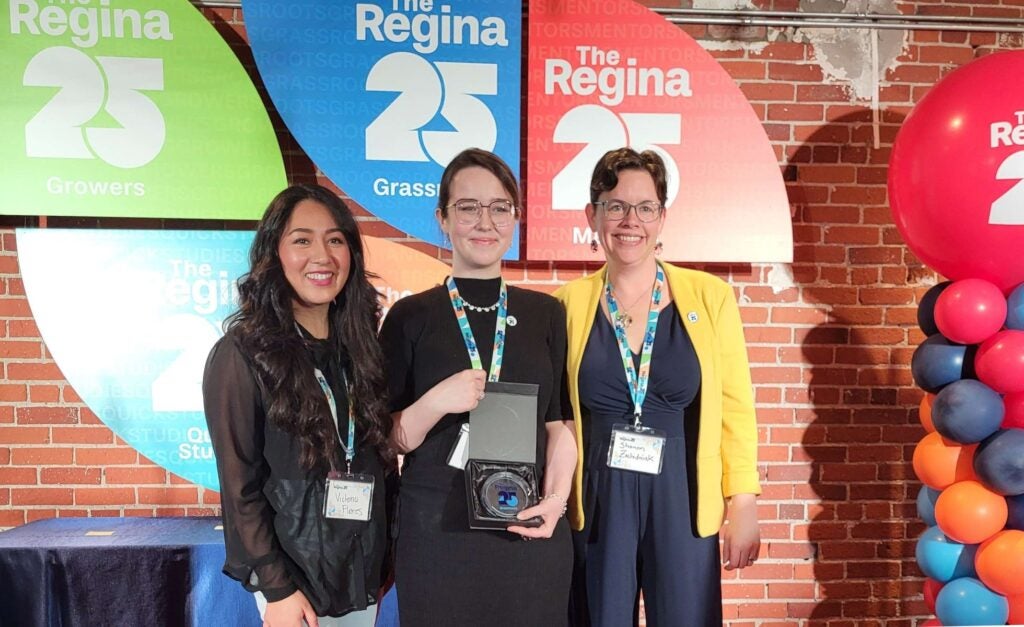
Kimberli Kolody-Watt (centre) was named one of Regina’s top 25 change makers for her work on fare-free transit and inclusivity. She is pictured here with Regina city councillors Victoria Flores and Shanon Zachidniak.
When Kimberli Kolody-Watt joined Better Bus Youth, a youth-run organization that advocates for fare-free transit in Regina, she never imagined that it would, as she says, “change everything about me.”
Now a high school graduate who recently completed her time as a David Suzuki Foundation Gaptivist, Kimberli recalls attending her first Better Bus Youth meeting, intending to help by moving tables and boxes at events.
“I was keeping to myself a lot,” she says. “I was really quiet, in my own space. And I was like, oh, I can help with boxes because I don’t think my ideas are very good.”
But Sophia Young, who led Better Bus Youth at the time, noted Kimberli’s keen interest in transit issues and encouraged her to share her ideas. Over time, Kimberli began to take on more responsibilities, acting as a media spokesperson and eventually leading the organization.
On January 29, 2025, the day after her 18th birthday, Kimberli spoke to Regina city council, presenting a motion to explore a long-awaited fare-free transit pilot for high school students. It passed unanimously.
Youth lead Regina’s fare-free transit movement
Regina’s young people have been at the forefront of the fare-free transit movement since 2022, when Sophia and her peers founded Better Bus Youth. Their first big success came when city council agreed to make transit free for youth under 13. But the group didn’t want to stop there: their goal was (and still is) to make transit free for everyone under 18.
Young people benefit from fare-free transit in numerous ways. “When you support things like fare-free transit, you get kids to school and they get educated,” Sophia told the Foundation in a 2022 article. “And we know that when kids are educated, it lowers the rate of crime and helps bring more wealth and growth to the community.”
Better Bus Youth took inspiration from cities like Kingston, where transit is free for everyone under 18, and Halifax, which has worked with the provincial government to fund free-for-youth transit for 28,000 students.
As Kimberli mentioned in her presentation to council, students’ attendance and involvement in school improve when they have a reliable and safe mode of transportation. And when people ride the bus for free as kids and teenagers, they’re more likely to continue to use transit as adults.
A personal connection to transit advocacy
For Kimberli, advocating for fare-free transit isn’t just logical, it’s personal. As she told council in her speech, “Transit brings us from point A to point B, but for me and many others, there are obstacles to getting around the city.”
She spoke about growing up in a single-parent household and how difficult it can be for single-income families to afford transit (a youth transit pass in Regina costs $600 a year). On several occasions, Kimberli had to walk to and from school — an hour-and-a-half round trip — because she didn’t have enough money for the bus. Even when she and her siblings did have a ride to school, they often struggled to get there on time because of their mother’s chronic illness.
“No one in Regina should have to struggle to get to work or school or other activities, in my opinion,” she told council. “But we do.”
Her ultimate goal, she said, was to graduate from high school and see her siblings graduate too. Achieving this would require getting to school on time every day.
Being a media spokesperson and speaking to city council put Kimberli in the spotlight in a way she’d never experienced. Fortunately, most of the feedback she received was positive. Once, a woman stopped her on the street, having recognized her from a TV interview. The woman explained that she was a grandmother, and she tearfully thanked Kimberli for her work, which would make a profound difference to her family. Not having to pay for transit would help her afford food and allow her grandchildren to get home safely.
“That’s the main reason why I supported this [motion to council],” Kimberli says. “I wanted people to have accessible, reliable transit and get home safely.”
“That’s the main reason why I supported this [motion to council],” Kimberli says. “I wanted people to have accessible, reliable transit and get home safely.”
Celebrating successes and looking ahead
The fare-free transit pilot project began in September at F.W. Johnson Collegiate and will last until January 2026. Council plans to assess its effectiveness by comparing student attendance records during the project to the four months that follow, when students will once again have to pay for transit. They’ll also survey students to determine how much they rely on transit to get to work or other activities.
Now that Kimberli has graduated, she has moved on from her role at Better Bus Youth. But she hopes to continue to advocate for a more equitable, accessible and sustainable city.
“I’m more in the community now,” she says. “I feel like I can help anywhere after [working with Better Bus Youth].”
Her advocacy isn’t limited to transit issues. Kimberli also founded a gay-straight alliance club at her high school, where queer students could hang out and feel safe.
“It’s had its ups and downs, but it taught me to fight for what I believe in, especially along with what I was doing for Better Bus Youth,” she says.
Earlier this year, Kimberli was named one of Regina’s top 25 change makers for her work on fare-free transit and inclusivity.