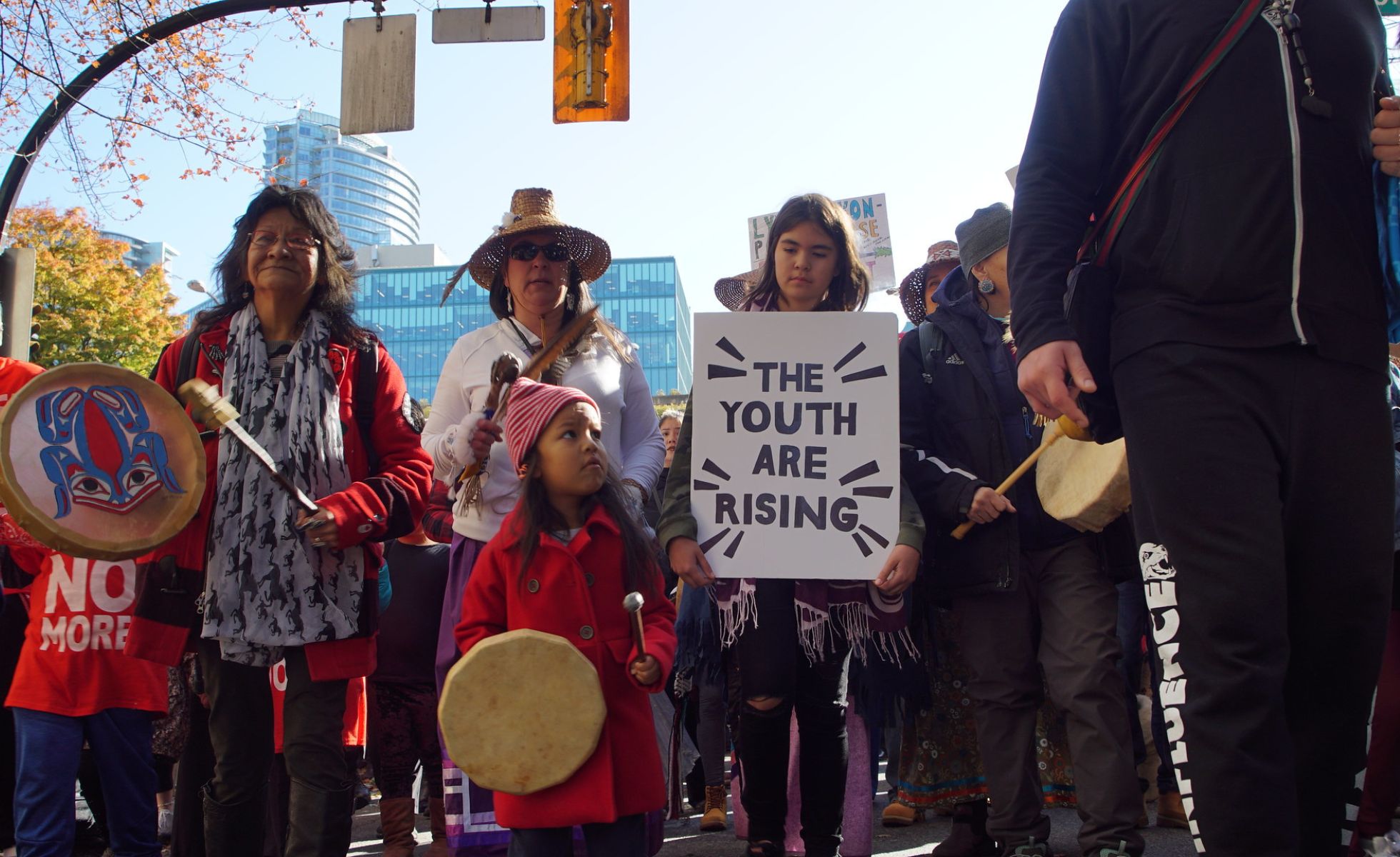
Youth Litigation Launch, Vancouver Oct 25, 2019. (Photo: Trevor Leach via David Suzuki Foundation)
Growing up, I wanted to be an actor — to make art, to tell stories, to live a life of whimsy and wonder.
On January 20, Prime Minister Mark Carney spoke in Davos, Switzerland, at the World Economic Forum annual meeting. He invoked Václav Havel’s The Power of the Powerless, reminding the room that power does not endure because it is true but because we agree to perform it. Systems hold only as long as we act as if they are real. Their fragility is revealed the moment someone refuses — when the greengrocer takes down his compliant sign and the illusion begins to splinter.
Carney called on companies and countries to take their signs down.
But from where I stand, as an Indigenous woman, an environmentalist and a young person living inside the climate crisis, the signs have already been taken down. Or perhaps, more honestly, they were never ours to hang in the first place. Indigenous Peoples, scientists, youth, land defenders, environmentalists, activists and advocates have been refusing this performance for generations. We have long named the lie that extraction is inevitable, that oil and gas are synonymous with survival, that there is no other way to live.
The colonial system endures because we have been trained to accept ecological collapse as normal.
The colonial system endures because we have been trained to accept ecological collapse as normal. Fossil fuel expansion is framed as economic necessity; extraction is rebranded as “transition”; sacrifice zones are dismissed as acceptable trade-offs. The oil and gas industry has embedded itself so deeply into the fabric of Canada — and much of the world — that when we call for a just transition, it is heard not as a demand for justice but as a threat to economic stability and political order.
How do we break the illusion when those with the most power keep reciting their lines? We keep speaking back, not as performers in a broken play, but as people insisting on a different story altogether.
Despite Carney’s words about the importance of aligning with other middle powers, we can see where real power sits in this country, as illustrated by the Canada–Alberta memorandum of understanding, which positions Canada as an “energy superpower.” In many ways, this is a politer Canadian echo of President Donald Trump withdrawing the United States from the Paris Climate Agreement… again.
In many ways, this is a politer Canadian echo of President Donald Trump withdrawing the United States from the Paris Climate Agreement… again.
Carney’s acknowledgment of the climate crisis while fast-tracking major projects, and Trump’s outright denial, both rest on the same quiet assumption, that we will be fine — buffered by wealth, borders and our standing in the Western world. That sense of safety has always depended on who is allowed to be protected and who is deemed expendable in service of maintaining the colonial order.
In the same speech, Carney acknowledged a fundamental rupture in the so-called “rules-based international order,” arguing that it no longer operates as advertised and is instead “a system of intensifying great power rivalry where the most powerful pursue their interests using economic integration as a weapon of coercion.”
This order is meant to rest on multilateralism, sovereignty, the rule of law and human rights. Yet in practice, Canada reproduces this coercive logic domestically through extractivist economic integration, using trade, resource development and capital flows to consolidate state power while sidestepping its legal responsibilities. Despite endorsing and committing to implement the United Nations Declaration on the Rights of Indigenous Peoples, Canada routinely overrides Indigenous sovereignty and reduces free, prior and informed consent to a procedural checkbox rather than a binding legal standard.
Despite endorsing and committing to implement the United Nations Declaration on the Rights of Indigenous Peoples, Canada routinely overrides Indigenous sovereignty and reduces free, prior and informed consent to a procedural checkbox rather than a binding legal standard.
Human rights violations are rendered acceptable as long as they serve economic growth, resource security or geopolitical positioning. These harms are not incidental; they are structural, and they are borne disproportionately by Black, Indigenous and other racialized communities. What is framed as national prosperity is, in reality, the domestic continuation of a broken international order — one that treats land as a commodity, law as flexible and life as expendable in service of extraction.
Young environmentalists live with the constant anxiety of knowing what the climate crisis is still becoming, alongside the clarity that colonialism and extractivism are the engines driving it. We inherited a crisis engineered to exhaust us, to normalize sacrifice zones and to make survival feel like the only possible horizon. In some ways, it has succeeded. But in others, it has radicalized us, pushing us to confront governments, corporations and economic systems built on extraction, so generations after us are not born into crisis management but into lives where dreaming is possible again.
Radical joy becomes an act of resistance, a refusal to let grief be the only inheritance we carry, and a refusal to let systems built on stolen land steal our capacity to hope.
It must be exhausting, maintaining the colonial order — finding new ways to steal the futures of children while calling it growth. This reality reshapes the lives of children and young people — especially those already carrying the weight of climate collapse, unjust policies and rising xenophobia. It alters not only the conditions of our lives but also the direction of our becoming. This pattern repeats throughout history: futures are constrained early, resistance is made harder and injustice is sustained. How do we fight when we are forced to live in a constant state of survival?
And while advocacy — being an activist, a land and water defender and fighting injustice — is a beautiful way to spend our lives, it does not erase the grief of the lives we once imagined for ourselves as children. Back when we could dream with imagination, hope and joy, without the constant fear of wildfires and floods, or politics and international law treated as mere suggestions.
So as we protect lands and waters, as we become scientists and lawyers, politicians and leaders, we cannot let grief steal our wonder, our hope or our whimsy. Radical joy becomes an act of resistance, a refusal to let grief be the only inheritance we carry, and a refusal to let systems built on stolen land steal our capacity to hope.

Skw'akw'as (Sunshine) Dunstan-Moore, Indigenous Climate Advocate and Indigenous Projects Manager with Finance Engage Sustain
Skw’akw’as (Sunshine) Dunstan-Moore (she/her) is Nlaka’pamux, Stl’atl’imx and Yakama from Tlekemstin (Lytton), B.C. A Global Law student at Carleton, she has five-plus years in climate policy, chaired ECCC’s Youth Council (2022–24), served on UNESCO’s Youth Advisory Group, co-chaired Y7 Peace & Security and manages Indigenous projects at Finance Engage Sustain.