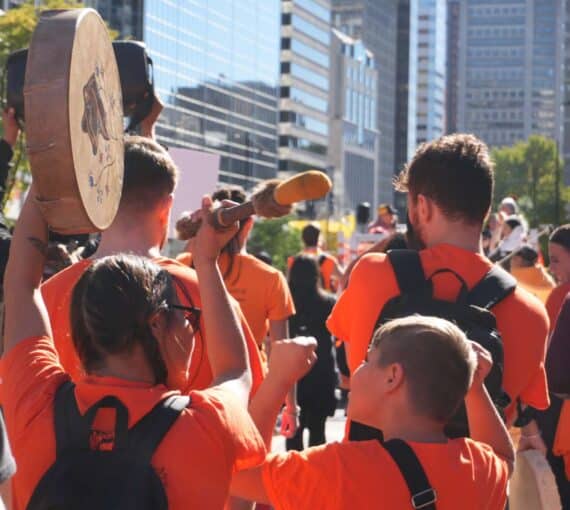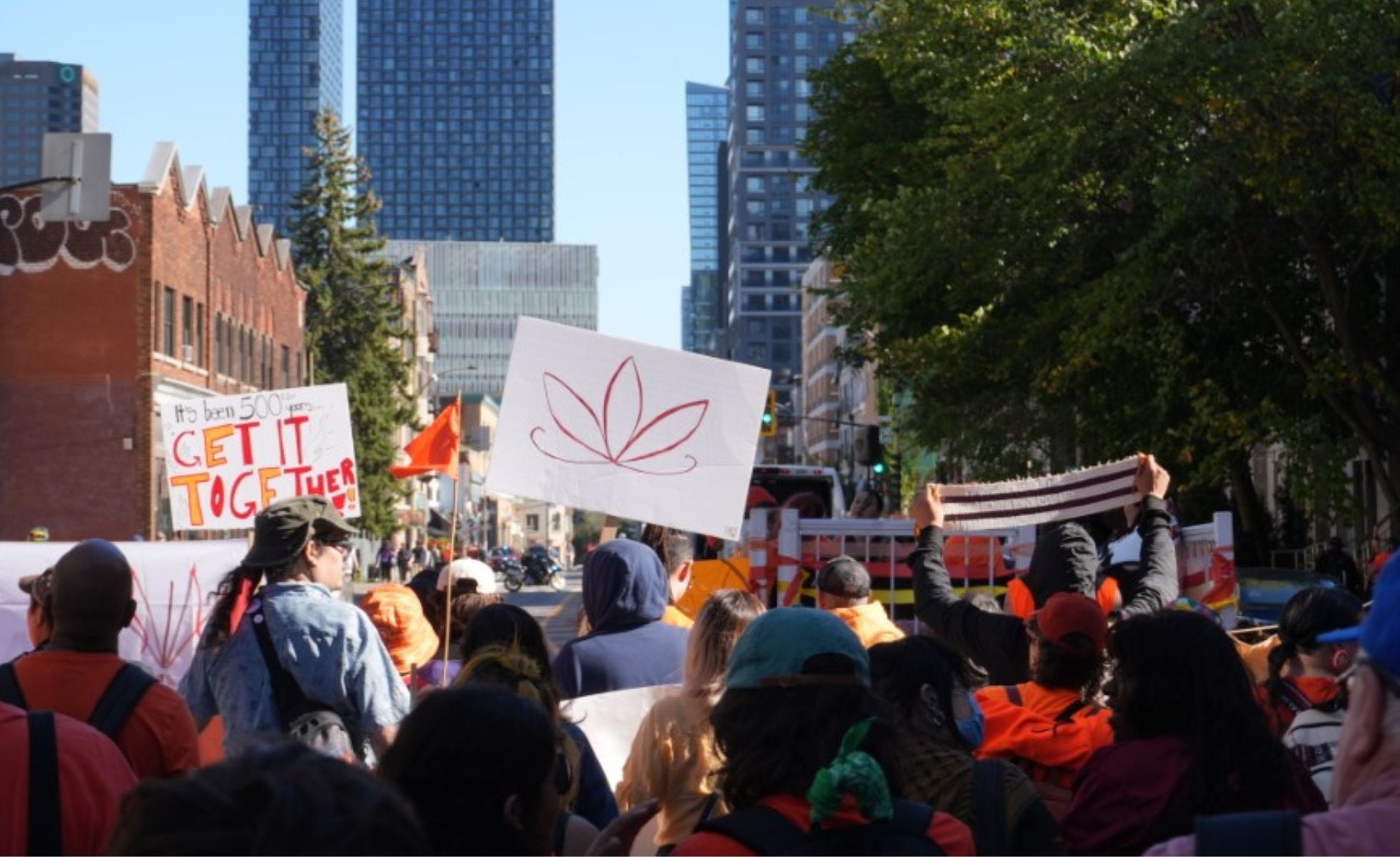
An Every Child Matters march in Montreal, 2025 (Photo: Laurence Bolduc for David Suzuki Foundation)
Over the years, more and more Indigenous leaders have been creating a path for younger generations to have greater opportunities.
With many new organizations and programs, Indigenous youth in Quebec now have access to numerous resources through their communities, schools and nations. Indigenous clubs and centres in cities and schools help with transitioning from community to cities for schooling and finding likeness and comfort.
The Cree School Board and Kahnawà:ke Education Center share the goal of distributing post-secondary funding for Indigenous students, as well as providing support and services. Offering easy access to guidance counsellors, help with financing and even just safe spaces, these programs help students gain equal opportunities in education and the workforce.
However, public services for youth are declining more than ever, and it is crucial that emerging political leaders more explicitly support Indigenous youth. Upcoming elections in Quebec must also focus on benefiting and prioritizing young Indigenous people and their futures.
Programs to support Indigenous youth are crucial in Quebec, as significant language barriers exist between many Indigenous communities and Quebec school systems. Global News says a report from Quebec auditor general Guylaine Leclerc states, “When Indigenous students, many of whom don’t speak French fluently, transfer from schools in their communities into the province’s education system, they are given insufficient support, such as language training.” This language barrier undermines their ability to succeed.
In the 2022-23 academic year, 10 per cent of Indigenous students in French schools received language support, compared to 46 per cent of immigrant students.
According to Global News, Leclerc’s report says, “funding for Indigenous student language support is ‘minuscule’ compared to what immigrant students in the province receive. In the 2022-23 academic year, 10 per cent of Indigenous students in French schools received language support, compared to 46 per cent of immigrant students.” As well, the government does not offer as much support for children who transition from community- to city-based schools, affecting their success and graduation rate. Alison MacLeod, an Indigenous student completing her master’s degree in medical anthropology, says that although she’s enjoying her program and the community she’s found in school, being the only First Nation student in many classes was tough, creating tension when sensitive topics come up in class.
According to Statistics Canada’s 2021 Census, just under half (49.2 per cent) of Indigenous people aged 25 to 64 have completed a post-secondary qualification, most commonly a college, CEGEP or other non-university certificate or diploma. The overall rates of post-secondary completion were 45.3 per cent for First Nations people, 56.3 per cent for Métis and 33.6 per cent among Inuit, compared to 68 per cent for the non-Indigenous population. These statistics highlight a persistent gap in educational attainment between Indigenous and non-Indigenous populations in Canada. The disparity reflects long-standing systemic barriers that affect access to education and opportunities for Indigenous communities.
When young people see family members pursue post-secondary studies, education becomes a realistic and attainable path for them.
Sarah Pash, chair of the Cree school board from Chisasibi, Quebec, explains that “statistical knowledge about what we have on post-secondary attainment in families [shows] that children of parents that have post-secondary degrees are more than twice as likely to attain similarly [results] in their schooling.” She emphasizes that increasing access to higher education has a generational impact within Indigenous families and communities. When young people see family members pursue post-secondary studies, education becomes a realistic and attainable path for them.
In addition, the remoteness of many Indigenous communities greatly affects graduation rates, as the major life transitions associated with moving away for post-secondary studies can be difficult. Statistics Canada notes that “the share of Indigenous people with a postsecondary qualification was higher in more accessible areas, with rates of postsecondary education generally declining with higher levels of remoteness.” In 2021, 54.7 per cent of Indigenous people living in easily accessible areas completed a post-secondary qualification, compared to 42.9 per cent of those living in remote areas and 27 per cent in very remote areas. This demonstrates how geographic isolation continues to create barriers to higher education.
As CTV News reports, “Many Indigenous students start their education in their own communities and later change into Quebec’s education system. According to the auditor general, of 31 First Nations communities (other than Cree and Naskapi), 23 have a school, and secondary education isn’t fully offered in eight of them.” This means many students must leave their communities at a young age to continue their education.
These challenges show that one of the main issues affecting Indigenous education is the lack of support, including financial assistance, resources for major transitions such as moving away from home and language and cultural support within the education system.
These challenges show that one of the main issues affecting Indigenous education is the lack of support, including financial assistance, resources for major transitions such as moving away from home and language and cultural support within the education system.
MacLeod claims that the Cree school board funding was “an amazing help,” but being one of the few Indigenous grad students in the city is isolating. In 2024, the Canadian Press reported that Leclerc said the Quebec government had been aware of a significant gap in academic success rates between Indigenous and non-Indigenous students since at least 2005 but failed to adequately address the issue. She also noted that, as of 2021, Quebec had the highest proportion among Canadian provinces of Indigenous people aged 25 to 34 without a diploma or certificate.
On the other hand, community-driven education initiatives and involvement have increased over the years, as programs continue to be developed, funded and improved. It is important to recognize the years of effort invested in these initiatives and to use this progress as motivation to encourage Indigenous people to pursue leadership and other influential positions.
Chief Irene Neeposh of Waswanipi First Nation says, “We need to find ways to encourage education for Indigenous people because we are looking at a way to re-appropriate governance.” She says the Western system doesn’t support students in Indigenous communities and that an understanding of different ways is necessary to adapt and develop a system that works well for Indigenous students.
It’s time to motivate each other and find solutions to these issues. The Quebec government, along with the rest of Canada, needs new young voices and leaders to propose solutions, as these issues have been simmering for decades.
It’s time to motivate each other and find solutions to these issues. The Quebec government, along with the rest of Canada, needs new young voices and leaders to propose solutions, as these issues have been simmering for decades.
It’s crucial to appreciate the organizations and people putting in the effort to make change. Neeposh believes better communication and encouragement can help Indigenous students to realize “that they have the ability to obtain the knowledge that has been taught in the Western education system. It might take a little more time or require a different route, but it isn’t impossible. If you want it, you can get it.” It can be tempting to give up and assume that with everything going on in the world, our actions are meaningless, but we have a chance to be different in the best way.
With upcoming provincial elections in Quebec, political leaders have an important opportunity to demonstrate that they are willing to invest in Indigenous youth and to show that Indigenous communities are not separate from but are integral to the societies we share and the land we live on. Governments must take responsibility for addressing the social, political and environmental challenges that affect all communities, including the persistent inequalities Indigenous Peoples face.
Voter turnout among youth, especially Indigenous youth, remains low. As Montreal CityNews reports, “Younger voters … appear divided. Some say economic pressures weigh more heavily than constitutional questions, while others welcomed debate around identity and culture.” Political leaders must be transparent about their commitments and demonstrate through concrete policies how they plan to support Indigenous youth in areas such as health care, education, climate action and economic opportunity.
The barriers that Indigenous youth face in education and leadership are not the result of a lack of potential but of systemic inequalities. Despite these challenges, many Indigenous leaders emphasize the importance of perseverance and education as tools for change.
MacLeod encourages students to “keep going and stay strong. It’s going to be tough. … you might face discrimination. You are basically operating in a world that assumes you don’t exist or that doesn’t want you to exist anymore … and what we’re doing by pursuing education is we’re resisting that.”
Pursuing education, leadership and political engagement is not only a personal goal but also a form of resistance and empowerment.
Pursuing education, leadership and political engagement is not only a personal goal but also a form of resistance and empowerment. With continuing support for Indigenous youth and meaningful government investments in their futures, education can be a powerful path toward strengthening communities and creating a more equitable society.

Maya Jiyâmeyihtam Brousseau, contributing writer with the David Suzuki Foundation
Maya Jiyâmeyihtam Brousseau (she/her) is a Cree-Lebanese undergraduate student completing her studies at Concordia University, majoring in political science. With family roots in Waswanipi First Nation in Quebec and in Beirut, Lebanon, her goal is shaped by a commitment to share new and diverse perspectives, not only to bring awareness but also to constantly learn. With a previous focus on work in communications with Indigenous organizations, such as Wachiya and daphne Art Centre, Brousseau found her inspiration in community engagement. From writing for the Concordian to now contributing to the David Suzuki Foundation, her focus on Indigenous and environmental issues inspires a strong desire to pursue writing, where she can foster awareness and amplify underrepresented voices on a professional level.