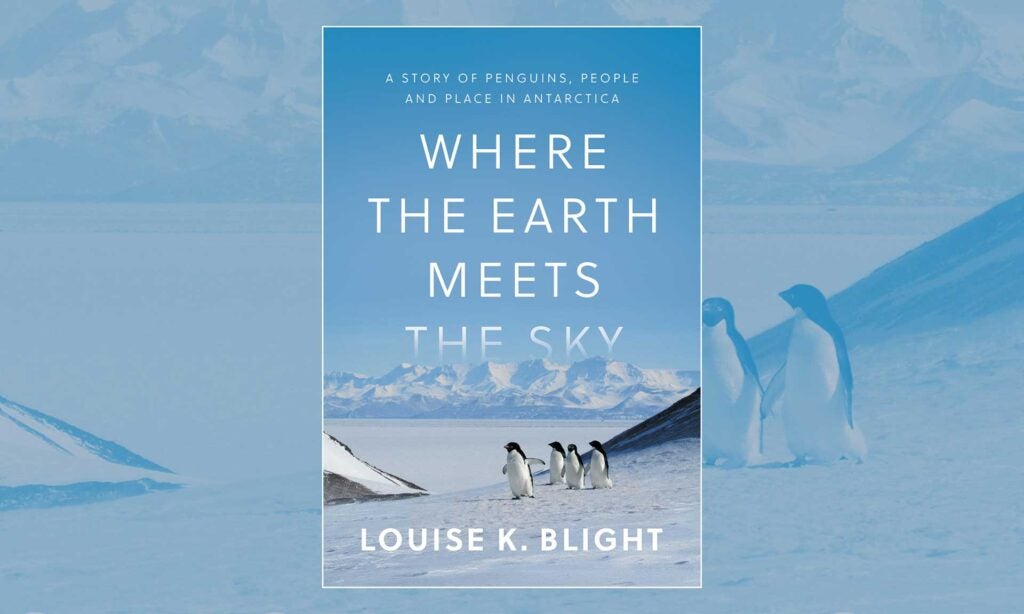
Louise K. Blight’s first book, Where the Earth Meets the Sky, recounts her experiences as a field assistant with renowned biologist David Ainley over a three-month field season on remote Ross Island in Antarctica. Throughout the book, Blight weaves stories of early polar explorers with present day narrative, including anecdotes about the motley human and wildlife crew she encounters. Blight and Ainley were in Antarctica to study the region’s Adélie penguins as part of a four-year project that looked at the impact of a giant iceberg on egg-laying and chick-rearing success. Although the book is peppered with information about the penguins and how they mate, incubate eggs and fend off predators, her observations about what it feels like to live in Antarctica and her reflections and experiences are what make the book so rewarding.
It was just what I needed. At a time when the world is experiencing acute geopolitical and ecological upheaval, its central themes of awe, healing and hope were a balm for an anxious heart. Through her book, Blight shines a light on Antarctica as an example of the very best of human scientific and international co-operation. As the book explains, Antarctica is governed by the Antarctic Treaty system, now acceded to by more than 50 nations. The treaty reserves the continent for peaceful, scientific and environmental purposes managed through consensus by consultative nations. Blight goes on to say that Antarctica “shows us what the world could be, a saner and more peaceable place.” The knowledge that a place globally designated as a nature reserve and devoted to peace and science still exists warms my conservation scientist’s heart.
Blight shines a light on Antarctica as an example of the very best of human scientific and international co-operation.
The book also highlights how truly valuable the Antarctic ecosystem is to science and our understanding of the natural world. Although Blight makes clear that humanity’s impact on the planet includes observable and frightening changes to Antarctica, she also explains that the Ross Sea is likely the last place to study how marine systems should work. She presents the concept of shifting baselines, to explain the intergenerational amnesia that affects each cohort of scientists, such that each generation has only the environmental conditions at the start of their career as a reference point. Thus, environmental information is lost over generations because people are not good at noticing incremental changes in the environment. Blight explains the challenges of working and studying in biological systems that are “already broken” (essentially everywhere except Antarctica). Antarctica offers a rare reference point and an opportunity to learn from our mistakes by providing a contrast in abundance of life to other places long since depleted of biodiversity. The concept of shifting baselines was recently explored by the David Suzuki Foundation in partnership with students from the University of British Columbia (where Blight earned her PhD in zoology). In this campaign we highlighted shifting baseline syndrome as critical to understanding society’s growing nature disconnect through a series of social posts and expert articles referencing the importance of historical records and oral histories to serve as the missing “baseline.”
Environmental information is lost over generations because people are not good at noticing incremental changes in the environment.
Central to the power of Blight’s book is her ability to create the feeling of being in Antarctica. Blight “bears witness to its beauty” and revels in feeling small in the “immeasurable landscape.” Blight also remarks on all that can be gained from listening to and being immersed in nature. Feeling awe from being in nature is something David Suzuki and I wrote about in a recent Science Matters column. In it, we talked about the importance of feeling small in nature as a catalyst for acting to protect something much larger than oneself. Blight captures this sentiment, as well as emphasizing the ability of nature to heal. She arrives in Antarctica still reeling from personal tragedy. Through her experience in nature, Blight remarks on the importance of “living life fully” and the healing power of nature. She reflects on the solace she has gained in reflecting on how fortunate she has been to have been in a beautiful world with others for a while.
Finally, Blight leaves us with a message of hope. Nature is resilient. We are introduced to penguin 1091 who is severely injured, unable to walk to her nest from the beach due to a likely leopard seal encounter. Blight documents penguin 1091 dragging herself up the main beach, spilling blood from her injured limb. Miraculously, after two days sliding on her belly, the penguin reaches her nest (a journey that would typically take 15 minutes) and manages to awkwardly perch on her eggs. Remarkably, penguin 1091 lasts the season, returning to the sea with her mate and hopefully back to the colony for the next breeding season. Reflecting on her experiences in Antarctica, Blight concludes that “knowledge of life’s persistence beyond our own is one of the comforts that nature offers us,” suggesting that our legacy as humans is inextricably tied to nature. In the end, Blight leaves the future of Antarctica (and all its inhabitants) in our hands, given that increasing interest in resources could lead to challenges in maintaining the consensus needed to keep the Antarctic Treaty’s strict protections in place. However, Where the Earth Meets the Sky makes it clear that Antarctica, and all nature, is worth fighting for.