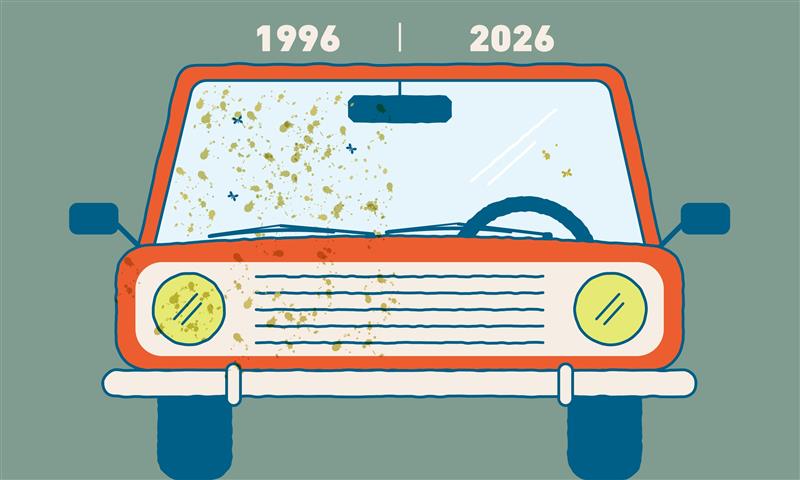
Not long ago, summer in the Pacific Northwest felt seasonal. Campfires were the norm, free from bans and fears of sparking catastrophic blazes. Windshield fluid had to be replenished after a long road trip — especially on rural highways or backcountry roads. We were lucky to get a week or two of hot weather.
Now, with drought alerts, heat and fire warnings and eerily fewer insects buzzing around the road, summer feels terminal. Many of us are old enough to be amazed at how quickly “normal” environmental conditions can change. Many of us are young enough to have never known anything different.
This latter inability to recognize the true scope of environmental change is a widespread phenomenon, called “shifting baseline syndrome.” Shifting baseline syndrome is “a socio-psychological phenomenon in which historical environmental information is lost over time and people do not notice changes in biological systems.” This concept was first coined by Daniel Pauly, a marine biologist at the University of British Columbia. In 1995, he observed that fisheries scientists evaluated changes in fish stock size and composition using the quantities at the beginning of their careers as a reference. With the next generation of fishers, fish stocks typically declined. However, each generation of scientists saw this degraded state as the new baseline, as there was, and still is, a lack of knowledge transfer between fishers. Without the passage of knowledge of environmental conditions, understanding of the magnitude of environmental change is lost. This ultimately shifts the condition’s “baseline,” which continues with each generation.
Shifting baseline syndrome is a socio-psychological phenomenon in which historical environmental information is lost over time and people do not notice changes in biological systems.
Shifting baseline syndrome is mainly linked to a lack of experience, memory and knowledge of historic conditions, typically caused by a lack of intergenerational communication about past environmental conditions and historical information. Studies have shown that older generations more readily recall accurate past environmental conditions compared to younger generations, indicating a “generational amnesia.” This gap between generations is happening through three avenues: lack of awareness or difficulties in accessing historical environmental data, lack of familiarity and knowledge of natural history and declining interactions between people and the environment. This last avenue is partly caused by increased urbanization, with fewer opportunities to interact with the environment, and partly because people are more inclined to go on social media or the internet instead of spending time in nature.
Why does it matter? Shifting baseline syndrome is increasingly recognized as a significant barrier to implementing policies and actions that could address some of today’s environmental challenges, because we misinterpret the scale and impact of change over time. When more experienced, older fishers fail to share their expertise and stories, newer fishers often accept the present ecosystem state without question. This can lead to less-effective measures being taken to address collapsing fish stocks because the resource decline was not recognized. This tolerance of degraded environments is one of many consequences of shifting baseline syndrome. When society gets used to a degraded environment as the baseline, further degradation will not be seen as something to be concerned about. With this generational amnesia and society’s decreasing contact with nature, we may see inappropriate conservation, restoration and management targets by policy-makers and stakeholders, and pushback against necessary conservation and restoration efforts. Even more concerning is the loss of public support for conservation measures such as the establishment of terrestrial and marine protected areas, which would go some way to halting environmental loss.
Shifting baseline syndrome is increasingly recognized as a significant barrier to implementing policies and actions that could address some of today’s environmental challenges
Shifting baseline syndrome is difficult to combat because it acts as an accelerating feedback loop. Trying to reduce its effects would take four strategies, suggested by researchers. The most direct action would be environmental restoration, specifically through rewilding efforts. As environmental degradation accelerates, this is of utmost importance to protect biodiversity. Second is to gather more high quality and consistent environmental data. This gives future researchers and scientists an actual, holistic baseline and makes them more informed regarding environmental conservation efforts they partake in. Furthermore, the broader public should be encouraged to increase interactions with nature to gain a better understanding and relationship with the environment. Finally, through public education, we can increase people’s familiarity with nature while also providing more accurate information on historic and current environmental conditions. Indigenous knowledge is crucial to limiting the syndrome’s effects, as it pushes forward the lived experiences of communities that recognize historic baseline conditions. In this way, sharing Indigenous knowledge is a remedy against generational amnesia.
Shifting baseline syndrome has been fuelled by the lack of connection that people have with one another and between people and the environment. In the article “Integrating historical sources for long-term ecological knowledge and biodiversity conservation,” the researchers highlight the value of historical data sources for providing a baseline for species and ecosystem change over time. Since beginning this initiative, we have pored over historical images and maps and read accounts of voyages from the 1800s describing vast schools of dolphins and porpoises playing about ships and a sea that abounds with fish. How much we have lost! Over the month of March, we will compare historical records with present-day imagery and historical storytelling to represent generational change. We hope that through our exploration of shifting baseline syndrome, we can encourage communities to reflect on changes they’ve observed and encourage action and advocacy for increased environmental protection, so that we can begin to halt biodiversity decline.