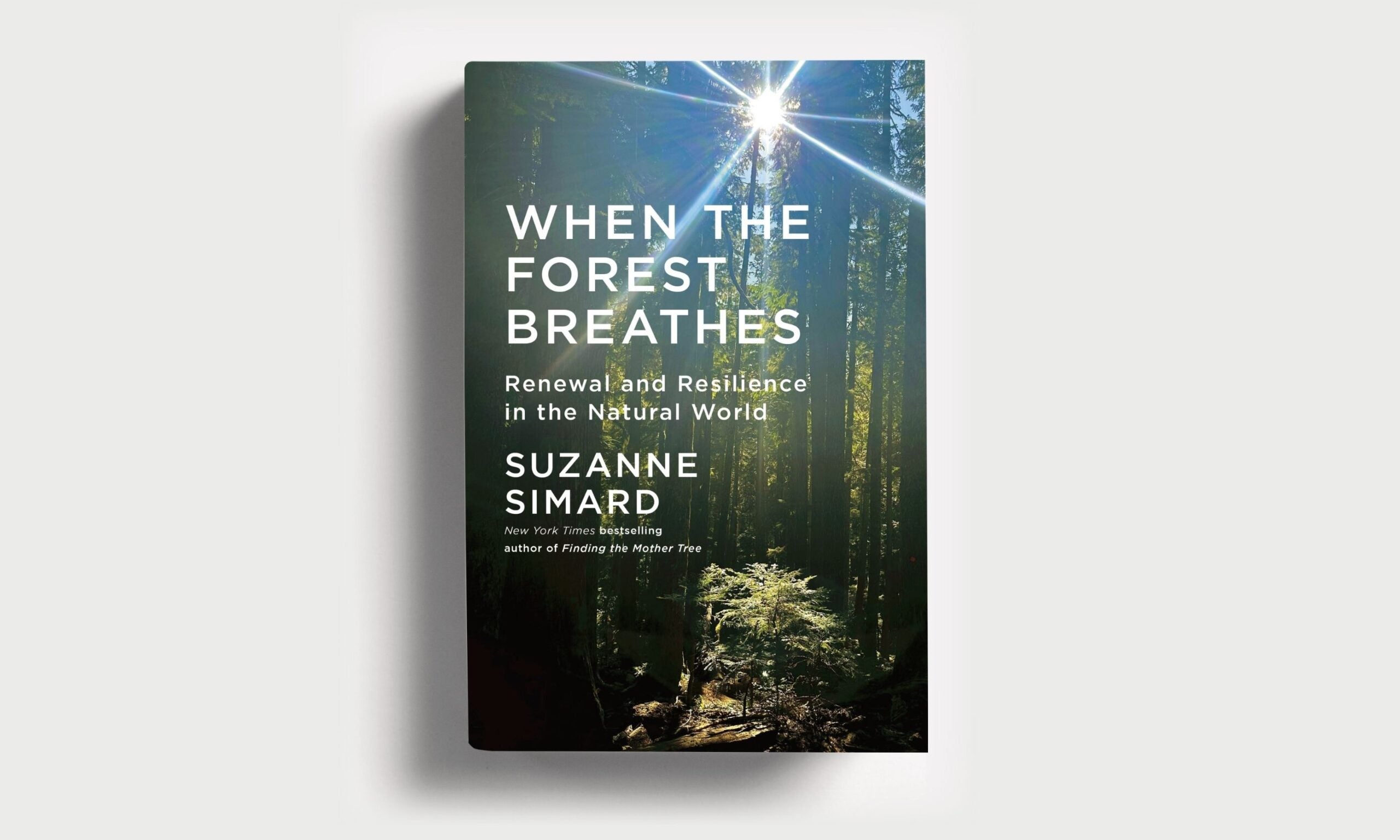
Forest ecologist Suzanne Simard’s new book When the Forest Breathes explores the steps we can take to help forests regenerate and flourish — and the lessons we can take to do the same ourselves. (Photo: supplied)
Suzanne Simard’s new book When the Forest Breathes: Renewal and Resilience in the Natural World is, in part, a love letter to forests. Simard notices each tree, plant, lichen and moss. She is fully abreast of the ecological roles they perform. Her first runaway bestseller, The Mother Tree, documented her finding that “old trees are essential to the rebirth of the forest,” as they nurture younger trees through mycorrhizal networks in the soil. Although her writing includes references to ecological functions (“Despite their diminutive size, mosses and lichens sequester one third of the world’s terrestrial carbon”), it also conveys her joy at being amid the lush biodiversity of B.C.’s old growth.
On the flip side, her book is a transcription of loss, as forest biodiversity is continually being wiped out by industrial logging in British Columbia. Due to her keen observation skills, scientific knowledge and sense of responsibility to the forest, the sense of loss in the book is detailed rather than vague. For example, she recalls a moment when she sheltered with colleagues inside a hollowed-out tree, noticing in it hairs from an overwintering bear who likely birthed cubs. When this tree is later logged, she muses about the bear returning with a full pregnant belly only to find the forest cleared.
The reader, knowing that the vast majority of old growth in the province has already been logged, is left to imagine the mother bear’s search to find a similar safe space in an ancient tree to birth her cubs. It’s funny, “’climate grief” is regularly referenced in our current emotional landscape, but less so “biodiversity grief,” though it is just as real.
Simard notes that some critics of her mother tree observations, “claimed there was no proof that big, old trees were the energetic centers of the forest, even though that fact was obvious to anyone walking through an old-growth forest.”
Not surprisingly, industry and government see forests differently than conservationists. I have often heard from them that it is obvious that trees (usually) regenerate after logging, which is tendered as proof that industrial harvesting practices are fine. Trees are cut down and new trees grow — the very definition, they claim, of a renewable resource.
To date, industry and the province of British Columbia, both of which receive economic gains from logging, have prevailed in maintaining status quo clearcut logging practices of old-growth forests, despite the fact that conflicts have waged within Canada to protect primary forests for over 30 years. The “war in the woods” in Clayoquot Sound began in the early 1990s. Little has changed.
When the Forest Breathes chronicles experiments undertaken by her organization, the Mother Tree Network, supported by graduate students, over a series of years to test the resilience of planted saplings under different logging regimes: clearcuts, areas where either 30 per cent or 60 per cent of old trees were maintained in patches through selective logging and unlogged forests.
In the face of this recalcitrance, Simard tested alternative harvesting methods to determine which approaches could maintain and restore forest health. When the Forest Breathes chronicles experiments undertaken by her organization, the Mother Tree Network, supported by graduate students, over a series of years to test the resilience of planted saplings under different logging regimes: clearcuts, areas where either 30 per cent or 60 per cent of old trees were maintained in patches through selective logging and unlogged forests.
Her findings reveal that selective logging — by maintaining old trees that shelter the understory, replenish nutrients and reseed younger generations — has the capacity to maintain functioning forest systems. Changes to industrial logging practices are necessary because, despite assurances from industry and government, ongoing regeneration of healthy forest ecosystems is not secure in forests where species’ interdependencies have been lost. As Simard notes, forests that grow following status quo logging and tree planting lack the diversity required to replicate processes carried out by natural forests: “Deprived of species and structural diversity, the monoculture plantations are unable to capture the full spectrum of light, water, or nutrients in an ecosystem.”
Simard is a lyrical writer, and one glimpses throughout the book the strength of her relationships outside of the forest — with her daughters, Indigenous colleagues such as Teresa Ryan, her best friend and co-project leader Jean, her grad students and other remarkable ecologists, such as Rachel Holt.
Relationships with kindred spirits working to halt and reverse biodiversity loss have long been one of the strongest salves to my biodiversity grief. Fighting against the colossal forestry industry is hard work, and those of us engaged in this fight care for and nurture each other.
Simard’s book provides a path forward, detailing the systemic changes needed to enable truly sustainable logging.
Simard’s book provides a path forward, detailing the systemic changes needed to enable truly sustainable logging. She notes that the deficits of the current forestry regime “can only be filled in by conserving remaining old-growth or primary forests, harvesting individual trees responsibly, carefully stewarding managed forests, and restoring forests that have been historically damaged.” This new model is not a once-size-fits-all approach but is rooted in place and could provide significant employment opportunities.
In the absence of sufficient momentum to launch a new model for forestry and forest restoration, status quo logging practices will continue. Simard has provided an alternate vision and, through her talents as a scientist and writer, made it accessible to the average reader, even those unversed in forest policies. Her call to action is clearly rooted in love for the forest. If only politicians and industry CEOs would read, and heed, her words.