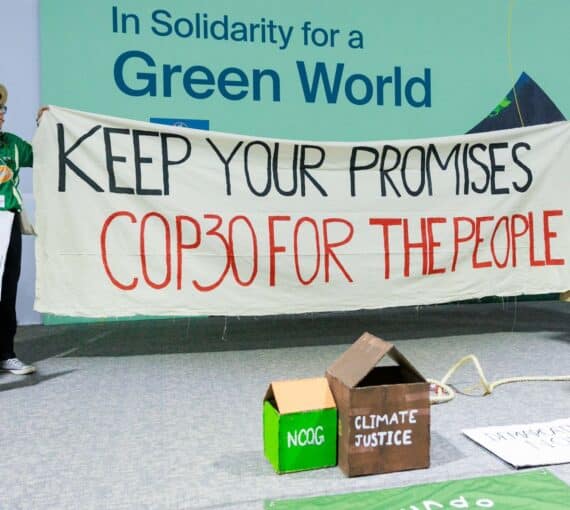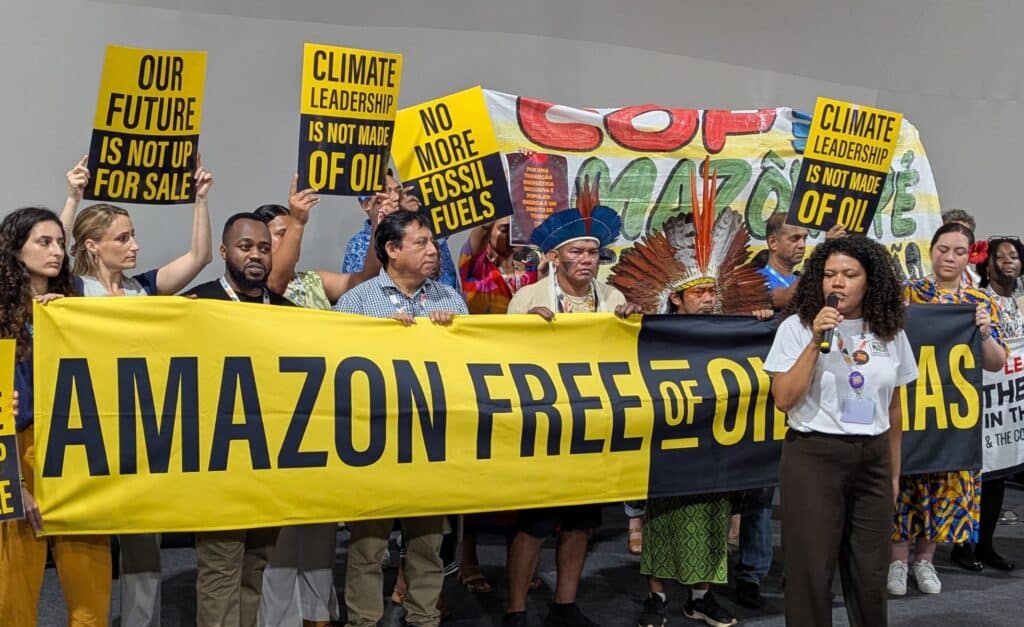
"COP of Truth" protest at COP30. After all those years, all that evidence, all the predicted impacts now descending on us, delegates to November’s COP30 in Belém, Brazil, could not agree on the necessity to “transition away from fossil fuels”. (Photo: Cyrielle Maison)
It’s been 37 years since climate scientist James Hansen warned the United States Senate that human activity was warming the planet, which would lead to unstable weather.

After all those years, all that evidence, all the predicted impacts now descending on us, delegates to November’s COP30 in Belém, Brazil, could not agree on the necessity to “transition away from fossil fuels” and whether wealthy countries responsible for most of the heating should pay to help poorer countries that bear the brunt of the impacts.
It’s absurd, tragic and stupid.
It’s good that all the world’s countries are meeting regularly to discuss these issues, but acting as if we still have time to deal with them is folly.
Countries including Russia, Saudi Arabia, the United Arab Emirates, India and others lobbied to remove any mention of fossil fuels from the final agreement. The U.S. government is now in full denial about the crisis and didn’t even send representatives. Canada appears to be giving up, moving full steam ahead on liquefied “natural” gas expansion and more pipelines.
Does our species care so little about our children and those yet to be born that we would sacrifice their futures for some illusory short-term gain and massive profits for oil industry executives and shareholders?
It shouldn’t need to be repeated, but even if we stopped burning coal, oil and gas immediately and protected natural systems that store carbon — such as forests, wetlands and the ocean — Earth would continue to heat as these gases remain in the atmosphere for a long time.
There’s no justification for it. We use excessive amounts of energy and consume too many goods, especially in countries such as Canada and the U.S. We could reduce emissions and other environmental damages if we just stopped using so much.
What will it take for us to address the climate crisis with the urgency and seriousness it demands? How much more evidence do we need?
Renewable energy is far more efficient, less expensive and more secure than fossil fuels. Shifting from coal, gas and oil to renewables would create far more good jobs, economic benefits and cleaner air, water and land.
It’s good that all the world’s countries are meeting regularly to discuss these issues, but acting as if we still have time to deal with them is folly. That fossil fuel lobbyists and industry representatives outnumber delegates from many of the countries most affected is also a recipe for failure.
What will it take for us to address the climate crisis with the urgency and seriousness it demands? How much more evidence do we need? All credible scientists who study climate-related topics, from oceanography to atmospheric physics, agree that our actions are rapidly heating our only home to dangerous levels, that we’re teetering over disastrous tipping points, that the impacts are accelerating at alarming rates.
Almost all agree on the overall solutions: We must stop exploiting and burning fossil fuels and protect and restore ecosystems that sequester carbon and keep it from entering the atmosphere.
We have a relatively recent consumerist economic system — fuelled by oil, gas and coal — that we now know is causing great harm and putting all life at risk. But we refuse to change our ways.
But we’re up against a sector that puts massive amounts of money and resources into spreading disinformation, creating organizations that mislead the public about the crisis, controlling news media that downplay or reject the evidence and sponsoring politicians to look out for industry interests at the expense of the people they were elected to represent.
It’s bewildering and appalling. We have a relatively recent consumerist economic system — fuelled by oil, gas and coal — that we now know is causing great harm and putting all life at risk. But we refuse to change our ways. Even incremental change — already too little, too late — seems out of the question.
Politicians can’t seem to think of any ways to govern, to deal with the issues of production and distribution, than pillaging raw resources and selling them off as quickly as possible. So we burn more polluting fossil fuels, cut down more forests, pave over more wetlands, create more weapons…
When will it end?
COP30 shows the failure of our governance and economic systems to confront the greatest threat humanity has ever faced. We need a mass movement to demand change.