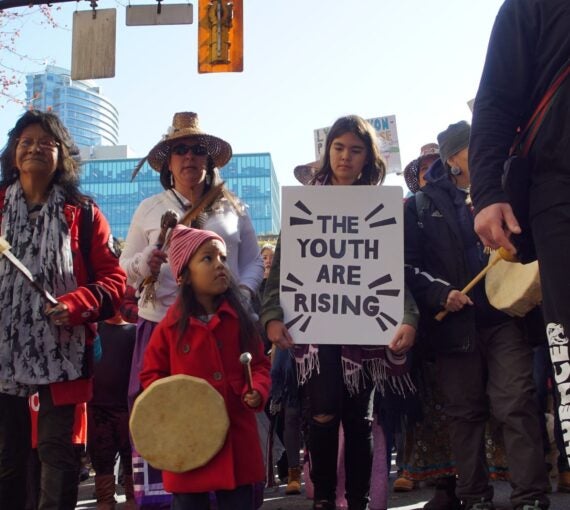
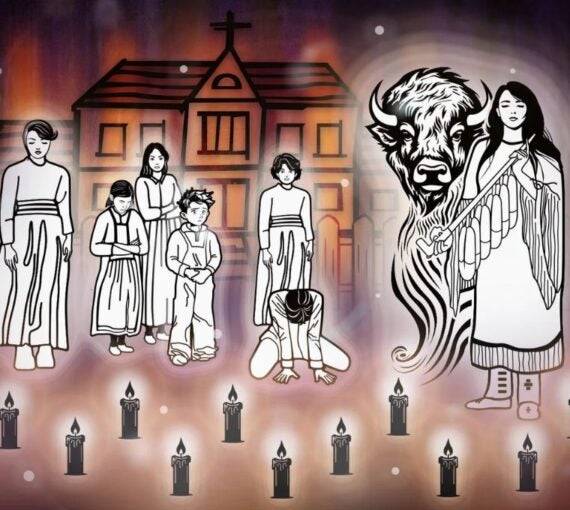
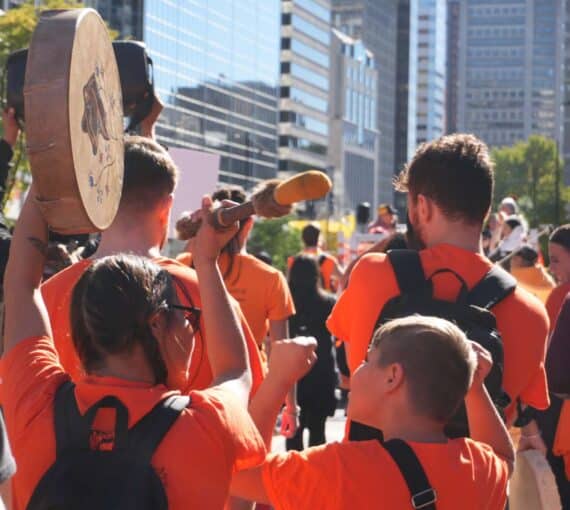
The 57th session of the Permanent Peoples’ Tribunal on Missing Indigenous Children and Unmarked Graves in Canada will be held in Tiohtià:ke/Mooniyang/Montreal in May 2026 (Photo: Pamela Buenrostro via Unsplash)
The international Permanent Peoples’ Tribunal is preparing to examine the cases of missing and murdered Indigenous children and unmarked graves in Canada, with the session scheduled for late May in Tiohtià:ke/Mooniyang/Montreal.
The Tribunal was founded in 1979 in Bologna, Italy, following the 1976 Universal Declaration of Peoples’ Rights in Algeria, as a permanent institution to hear from people experiencing human rights violations.
The 57th session of the Permanent Peoples’ Tribunal on Missing Indigenous Children and Unmarked Graves in Canada was in response to a request from the Native Women’s Shelter of Montreal.
In an interview provided by the Tribunal, Secretary General Gianni Tognoni explained the situation and process. “It was a ‘perfect model of colonization’ where not only was there a taking power of the land but of destruction of the culture or the population which were colonized,” he said.
Interview with Gianni Tognoni
Tognoni said this case is considered a “perfect model” because documentation is already available under a national commission, Canada’s Truth and Reconciliation Commission. “In reality, this was a cancellation of the culture of these populations in order not to be able to reproduce or to prolong their identity.”
He added that “the Tribunal considered that this session could be an even more important expression of what has been considered in other sections of the Tribunal, which had been, for instance, focused on cases like Guatemala where the violation of the Indigenous people resulted to be true and recognized as genocide in a verdict.”
Tognoni said the justification for sending Indigenous children to residential schools in Canada was that they would be educated into a life of dignity “while in fact they were ‘trained’ to be another culture, another population,” which is a societal violation.
Tognoni said the justification for sending Indigenous children to residential schools in Canada was that they would be educated into a life of dignity “while in fact they were ‘trained’ to be another culture, another population,” which is a societal violation.
“The colonization of a country like Canada, which is represented now as a model of democracy, has a history which has been most of the time denied,” he said. “And I think it’s important to combine a historical judgment with a judgment which could look up to the future.”
A judgment against those responsible is “interesting symbolically,” he said. “What is important is to see how to propose a judgment which indicates what are the failures of the present rights, which must be faced by the present government and the future one.
Because the better judgment and recognition of their rights is to help them receive back what has been stolen and destroyed in all times.”
Tognoni said this year’s session is likely to be long, “because the role of the testimonies … proposed by the organization would be very important and there would be much evidence to be confronted between what has been already presented in public hearings and what has been found in this situation.”
Although violations of the international law can be brought to the International Criminal Court or the International Court of Justice, Tognoni said those are not adequate in this case because, although criminal condemnation has been shown to be historically important, it hasn’t been that important for the future of a population.
“The Permanent Peoples’ Tribunal always prefers to imagine that the really important human rights are not looking to the past but to the future, in order to give effectively to the new generation a better opportunity for life.”
The Permanent Peoples’ Tribunal always prefers to imagine that the really important human rights are not looking to the past but to the future.
He added, “In this specific situation of Canada, the case has been present for a long time in the debates — in the political culture debate of Canada — without having a very satisfactory solution.”
He said the expectation is to have a verdict that could assist in the ongoing struggle of Indigenous people in Canada to assure restitution of their rights.
He said the expectation is to have a verdict that could assist in the ongoing struggle of Indigenous people in Canada to assure restitution of their rights.
As for the process, Tognoni said that once the Tribunal receives a request, the presidency and the general secretariat assess it to see whether the people and request are credible and can present reliable testimonies.
Those who are presenting their evidence are responsible for showing — together with the experts — how well the declared violations are documented and if this could allow a judgment.
“The Tribunal then organizes, with great flexibility, the public hearings, which could be of different lengths depending on the problem.” In the end, these are presented to the international community, the United Nations and to governments. “They are in fact advised that the procedure is taking place with respect to their responsibility in the violation.”
The Tribunal’s documents are always public and publicized, “and that could sometimes be very sensitive in regards to the accusation which we have made,” Tognoni said.