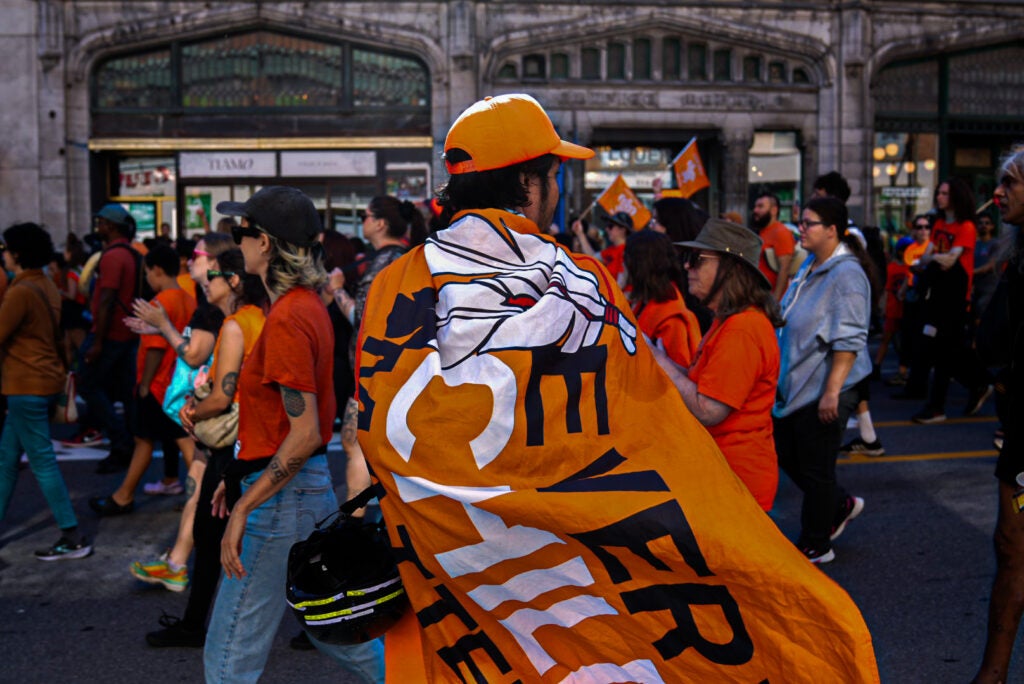
This year marks the 10th anniversary of the Truth and Reconciliation Commission’s report. It made 94 calls to action to help heal the relationship between Indigenous and non-Indigenous peoples on Turtle Island. What has changed in 10 years? (Laurence Bolduc / David Suzuki Foundation)
This year marks the 10th anniversary of the Truth and Reconciliation Commission’s report. It made 94 calls to action to help heal the relationship between Indigenous and non-Indigenous peoples on Turtle Island.
What has changed in 10 years?
What has transformed the relationship between Indigenous communities and all stakeholders in the Canadian government?
Steps initiated in 2007 led to an official apology from Prime Minister Stephen Harper in 2008, which acknowledged the role of the Canadian government in the establishment and maintenance of residential schools from the 1870s to the closure of the last one in Quebec in 1996.
In 2015, I had the honour of participating in the Truth and Reconciliation Commission as social media manager. I knew about the residential schools, but like many people in Canada, I discovered the extent of the horrors that were the daily lives of our parents and grandparents throughout the country.
I would have only personally known the “day schools.”
When the recommendations were unveiled, all the urgent aspects covering the need to repair the relationship with communities were highlighted, and much hope was placed in the report’s pages.
When Justin Trudeau’s government was elected, there was hope that a new relationship with Indigenous communities would become a reality in Canada.
The Yellowhead Institute’s 2023 report, “Calls to Action Accountability: A 2023 Status Update on Reconciliation,” stated that only 13 of the calls to action had been fully implemented since 2015 and that if Canada continued at this rate, it would not complete its task before 2081.
Do you know what won’t take 30 years to complete? Destruction of the land. In recent years, and particularly during the past year, a frantic race has been taking place in our forests and on our territories.
We are living in a “Wendigo” economy, an “Atshen” economy — the cannibalistic monster of our legends, who is condemned to always be hungry and never feel satisfied, to the point where he eats the people around him, his family and his children. Our economy is devouring the future of the next seven generations, the ability of its own children to survive. These legends date back to time immemorial and speak of human beings who, in times of famine, overstepped this human taboo.
The Wendigos are hungry!
Of all the recommendations I’ve heard over the past year, the one on “economic reconciliation,” number 92, is the most widely named of the 94 calls to action.
Once again, we see the true face of what I call “popcorn reconciliation.” It’s the kind that needs to be fast and effective, but not for communities. Here is this call to action:
Business and Reconciliation
92. We call upon the corporate sector in Canada to adopt the United Nations Declaration on the Rights of Indigenous Peoples as a reconciliation framework and to apply its principles, norms, and standards to corporate policy and core operational activities involving Indigenous peoples and their lands and resources. This would include, but not be limited to, the following:
- i. Commit to meaningful consultation, building respectful relationships, and obtaining the free, prior, and informed consent of Indigenous peoples before proceeding with economic development projects.
- ii. Ensure that Aboriginal peoples have equitable access to jobs, training, and education opportunities in the corporate sector, and that Aboriginal communities gain long-term sustainable benefits from economic development projects.
- iii. Provide education for management and staff on the history of Aboriginal peoples, including the history and legacy of residential schools, the United Nations Declaration on the Rights of Indigenous Peoples, Treaties and Aboriginal rights, Indigenous law, and Aboriginal–Crown relations. This will require skills-based training in intercultural competency, conflict resolution, human rights, and anti-racism.
Do you believe that communities are being consulted freely and in an informed manner, without constraints?
With all the madness of United States’ economic policies and tariffs, Canada has turned to resources that it will have to exploit unrestrained to keep investors from feeling economic pressure.
With all the madness of United States’ economic policies and tariffs, Canada has turned to resources that it will have to exploit unrestrained to keep investors from feeling economic pressure.
Bills such as C-5 (the One Canadian Economy Act) and Quebec’s PL-97 illustrate what has always been the modus operandi of the federal and provincial governments. The response, unfortunately, takes us back to 2020, when Canada went against its own laws and rights guarantees, displacing Wet’suwet’en matriarchs, who sang on their own territory before a sacred fire. Seeing the RCMP arrive and dislodge the women to help private companies was not “reconciliation.”
However, it did educate Canada about the reality that our political structures are more complicated than thought and, above all, that our rights have not been extinguished, even after 150 years of active colonization through the Indian Act and residential schools.
The limited consultation with our communities regarding these bills spells more of the same old 150 years of resistance to the Indian Act, assimilation policies and destruction of the land on this 10th anniversary.
The limited consultation with our communities regarding these bills spells more of the same old 150 years of resistance to the Indian Act, assimilation policies and destruction of the land on this 10th anniversary.
Let’s hope that reconciliation will not be reduced solely to economic reconciliation, which essentially means “If you want to be our friends, you must let us exploit your territories.”
We are already seeing economic stakeholders choosing the least inconvenient Indians for this reconciliation.