 Building relationships is work — fun, challenging, sensitive work. That’s been the lesson of Camp Suzuki, a program that grew over the past decade from a seed of an idea to becoming completely integrated with Camp Fircom today.
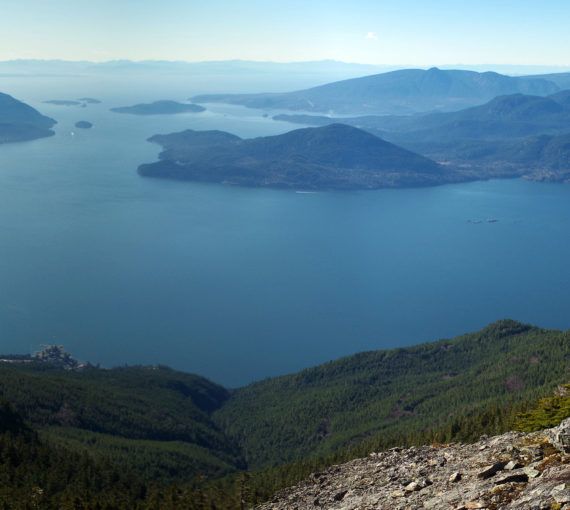
Since 2015, the David Suzuki Foundation has worked with the Squamish Nation, Ayás Ménmen and Camp Fircom to offer Camp Suzuki on Gambier Island, in Howe Sound on the traditional territory of the Squamish Nation.
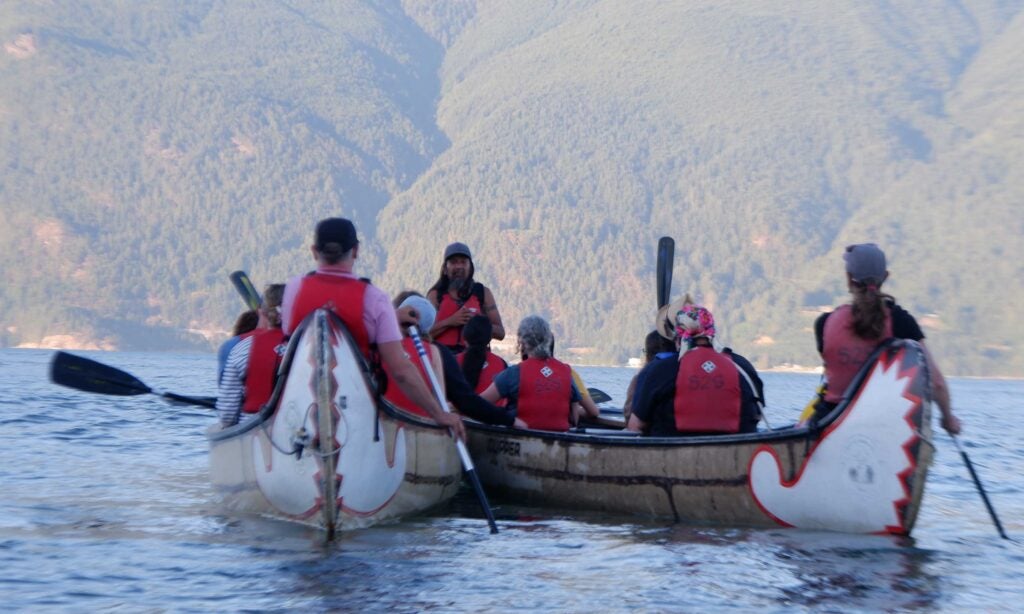
A multi-generational, nature-based summer camp that combines environmental stewardship and Indigenous-led outdoor education, Camp Suzuki was proof that, as one frequent camp-goer put it, reconciliation is very serious, and very fun.
Camp Suzuki was proof that, as one frequent camp-goer put it, reconciliation is very serious, and very fun.
In 2015, David Suzuki Foundation staff identified the need for a camp that could foster leadership among youth activists who wanted to participate in conservation campaigns. It then expanded to include adult, teen and kids’ camps running concurrently. The camp continued to evolve and soon incorporating Squamish teachings became central to its purpose. Originally called “Camp Suzuki: Howe Sound,” the name evolved to “Camp Suzuki at Chá7elkwnech: Walking with the Squamish” in 2019, reflecting increasing leadership from the Squamish people.
Learning from our Squamish partners, the David Suzuki Foundation shifted its role from leading the camp toward a full partnership. This made room for Squamish leaders to teach campers about their culture, language and traditional knowledge. Central to this full partnership model was the shift from inviting Squamish members to lead activities to ensuring they were part of the conversation and integral to all aspects of the camp. Relationship-building in which the same Squamish knowledge-holders and facilitators returned year after year and were involved in planning the next steps for the camp was crucial. We agreed to make the evolution of the camp part of our journey together. Reconciliation became a central pillar for a camp cultivating an appreciation for the region’s biodiversity.
Sometimes it is just as important to know when to lean back as it is to know when to lean in. This was the case with Camp Suzuki. We realized that with time Squamish leaders had become so embedded into Camp Fircom (not just for the Camp Suzuki week but throughout all of Camp Fircom’s annual programming) that a week dedicated to Squamish teaching wasn’t needed anymore.
Ongoing relationships and learnings are the legacy of Camp Suzuki. That is reconciliation in action.
Now Camp Fircom and the Squamish leaders have a relationship throughout the year that is integrated in every camp. The Foundation is proud to have helped with the relationship-building. Ongoing relationships and learnings are the legacy of Camp Suzuki. That is reconciliation in action.
This camp would likely not have gotten off the ground without the generous support of the Sitka Foundation. The David Suzuki Foundation thanks the Sitka Foundation for our long-standing partnership and for their trust in us to experiment with a program well outside traditional environmental conservation campaigns.

Our work
Always grounded in sound evidence, the David Suzuki Foundation empowers people to take action in their communities on the environmental challenges we collectively face.