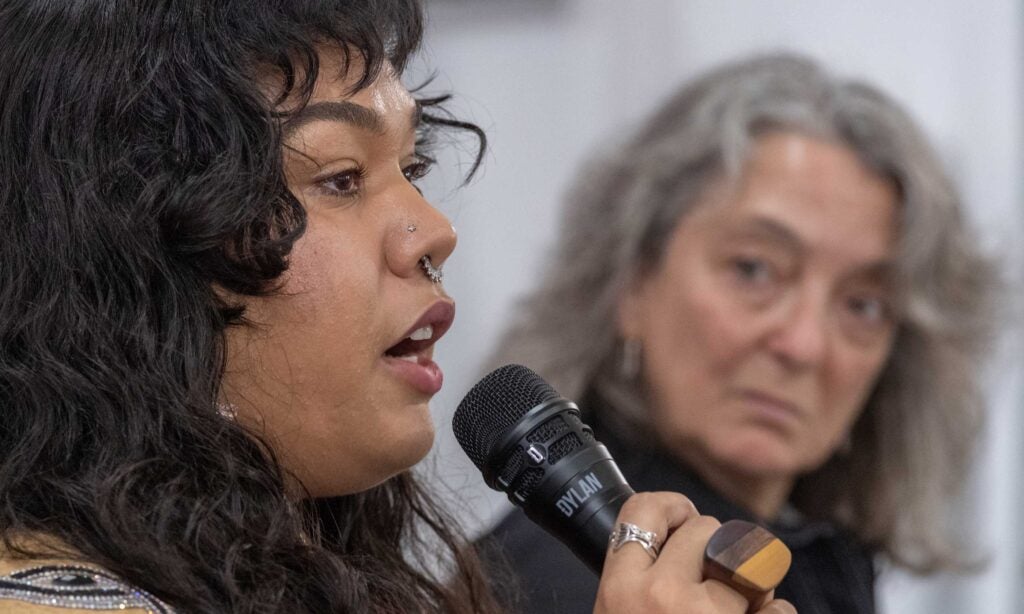
Janelle Lapointe and Minister Julie Dabrusin at COP30 in Belém, Brazil (Simon Chambers/ACT )
This article was first published at The Hill Times.
International Day of the World’s Indigenous Peoples on August 9 was supposed to celebrate, protect and promote Indigenous rights. The distance between the rights this day is intended to celebrate and the choices our government is offering Indigenous Peoples is difficult to ignore.
The United Nations Declaration on the Rights of Indigenous Peoples was adopted in 2007 by 143 votes to four, opposed by Canada, Australia, New Zealand and the United States. Canada later affirmed UNDRIP’s application in Canadian law but domesticated the declaration, turning self-determination into a process for managing Indigenous participation over decisions in which Canada has the ultimate say.
This was evident on July 2, when Prime Minister Mark Carney referred Alberta’s proposed bitumen pipeline to the Major Projects Office, promising prosperity and a meaningful equity stake for Indigenous communities. Yet, the corridor and ownership structure were announced before consultation began.
Carney is governing like a banker, applying corporate finance logic to a country. Public services and regulatory capacity appear on one side as costs to cut. Resources and energy systems appear on the other side as assets to be sold to the highest bidder.
The bidders reveal a lot about Carney’s “elbows up” nationalism. He built his campaign around resistance to United States President Donald Trump’s tariffs and annexation threats. Yet his government is fast-tracking projects like Ksi Lisims LNG, whose future operator is Houston-based Western LNG. Western’s financing has been anchored by Blackstone, the American private-equity giant led by Stephen Schwarzman, a billionaire investor and major Trump donor, who previously chaired Trump’s Strategic and Policy Forum. Carney’s elbows appear to be pointed inward, toward communities expected to clear the way rather than Trump and his inner circle.
Still, many applaud this approach, stating Canada has been closed to investment for too long. But this type of investment doesn’t guarantee public benefit; project risks are offloaded to the public. Investors profit while communities are left with higher utility bills, environmental cleanup and infrastructure that could become obsolete before its public financing is ever repaid.
Simultaneously, under the banner of “economic reconciliation,” a buzzword I criticized in the past, the federal Indigenous Loan Guarantee Program has doubled to $10 billion and Indigenous Services Canada plans approximately $494 million in annual reductions. Nations are told that the era of federal spending is ending and the era of Indigenous borrowing is here. Canada will not fund critical services for Indigenous people, despite decades of systemic impoverishment and land theft, but will enable nations to take on debt to participate in the extractive economy.
Indigenous nations are offered three pathways. The first is to partner on a project, despite cultural values, because promised revenue may seem like the only option. Once a nation becomes tied to a project, its leadership may be pressured to present participation as collective consent, even if members or neighbouring nations, with their own distinct rights under UNDRIP, disagree. If a project fails, these Nations will be left with financial debt and stranded assets.
The second is to say no to fast-tracked projects and prepare for lengthy litigation, injunctions, surveillance and front-line confrontation. This consumes scarce community resources and fuels anti-Indigenous racism by casting legitimate concerns as barriers to progress. It’s politically useful, conditioning the public to side with the investor and surrender protections enacted by Indigenous nations.
Lastly, many Nations won’t have any meaningful role in Canada’s “nation-building,” but they’ll still absorb climate conditions intensified by more than a century of burning fossil fuels. We’re seeing this unfold in Ontario. In July, First Nations made up the majority of communities evacuated because of northern wildfires. At Namaygoosisagagun First Nation, no emergency alert came. Community members went door to door and then fled by boat with minutes to spare. This is not exceptional. First Nations communities account for approximately 42 per cent of wildfire evacuations despite making up roughly five per cent of the population.
Canadians should understand that the systems don’t remain contained. They’re asked to cheer on weakening of environmental protections and overriding of Indigenous rights in the name of prosperity. By the time they encounter the consequences through higher utility bills, weakened public services, polluted environments and less power to raise concerns about projects, the precedent will be set.
A country is not a corporate portfolio. Indigenous rights are a critical line of defence against unchecked corporate power. When the elements of life that we depend on are treated as assets to be unlocked, everyone and everything, except the investor, becomes expendable.
Our work
Always grounded in sound evidence, the David Suzuki Foundation empowers people to take action in their communities on the environmental challenges we collectively face.