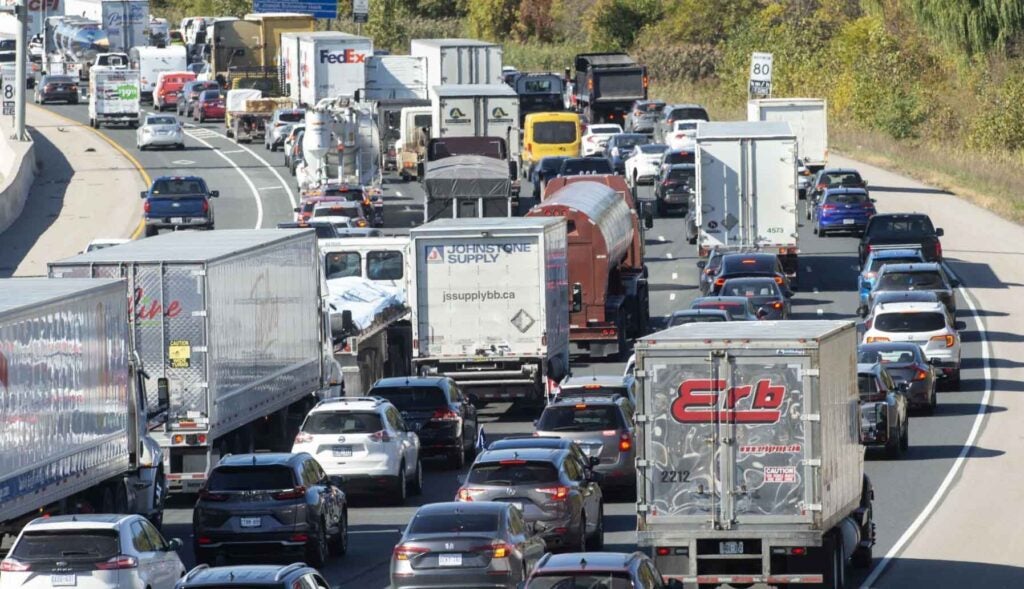
(Mathew McCarthy/Waterloo Region )
I work in the environmental movement — but I don’t live like those who are most committed to it.
One of them is my colleague and dear friend, Rachel. She hates zoos. Balloons. Fake plants. Disposable plastic trinkets. (Her own daughter sometimes calls her “the Grinch.”) She hates many of the things that, as a mother of two kids under five, I find myself surrounded by.
She’s not unique. One of my colleagues has never owned a car, won’t get on a plane and air-dries his laundry. Others bring their own takeout containers to restaurants, boycott fireworks and pay for specialized recycling programs at home.
They’re not wrong.
Zoos raise serious questions about captivity. Balloons end up in rivers. Single-use plastic trinkets fill landfills. Fireworks frighten wildlife. Cars and planes emit greenhouse gases.
I get it. I work for an organization founded by Canada’s most famous environmentalist, campaigning to protect biodiversity and challenge governments that treat nature as expendable. I see the pictures every day: wildfires spreading, plastic pollution in waterways, old-growth forests being logged, caribou left with nowhere to go.
I admire my colleagues’ commitment to their values, but I’m also in survival mode
I admire my colleagues’ commitment to their values, but I’m also in survival mode, having not really slept in five years. Between parenting and the cost-of-living squeeze, emotional bandwidth is scarce and environmental perfectionism feels unattainable.
It’s not only me.
For most of the people my partner — an immigrant from Zambia — and I know, this way of living can feel impractical and unrelatable.
Many of our friends work long hours. Some juggle multiple jobs. Some are sending money home to Zambia. Some voted for Doug Ford, not because they’re in favour of paving over the Greenbelt for another megahighway, but because they received a $200 rebate cheque in the mail.
My partner and his friends start work before public transit opens. As for me, navigating transit with two kids under five is my own version of hell, so I drive almost everywhere. We took our kids to the Toronto Zoo on Family Day because their school sent home a coupon. We blow up balloons and hand out loot bags filled with single-use toys on birthdays.
The disconnect isn’t about ignorance. It’s about time, money, convenience and bandwidth — all of which are in short supply.
the fight to protect the planet will be won in the space between the bubbles, where policy speaks to lived reality.
Both conversations matter. But the fight to protect the planet will be won in the space between the bubbles, where policy speaks to lived reality.
The real work isn’t convincing parents to boycott wrapping paper (but do so if you feel so inclined!). It’s redesigning systems so the sustainable choice is the affordable and convenient one — investing in public transit that makes it genuinely easier than driving, valuing nature as critical infrastructure and ensuring public subsidies reduce risk instead of expanding it. Instead of personal perfection, the goal should be building an economy where imperfect choices don’t carry such catastrophic consequences.
The good news is that our prime minister is an economist who understands markets, incentives and risk — and even wrote a book, “Values: Building a Better World for All,” that discusses climate change as an existential threat. If anyone can make the business case for treating nature as an economic fundamental, it should be him.
David Suzuki once said that courage is in short supply in Ottawa. A few weeks ago, I asked him what that would look like. He bristled, saying courage today is what you see in war-torn countries, where people are defending their rights and families in the face of violence.
He’s right. But it will still take a backbone for Mark Carney to prove he’s not practising politics as usual — to show, as he well knows, that protecting nature makes for sound economic policy, and that people across Canada can prosper not in spite of nature but because of it.
Imperfect people care. Tired parents care. Commuters stuck in traffic care. Voters of all stripes care. We just need systems in place that make the right thing easier to do.