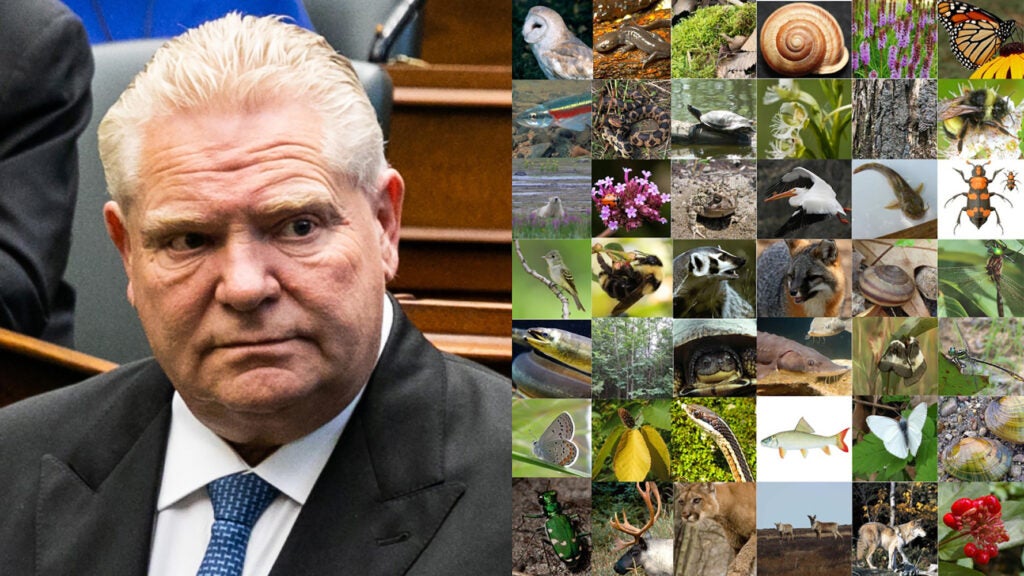
Ontario’s Unleashing the Economy Act would gut species protections and open the door to lawless development. Learn what’s at stake, and how you can fight back through petitions, consultations and creative action. (Image via The Pointer)
Have you heard the expression “flooding the zone”? It’s when politicians throw so many things at the public at once that we lose our ability to take it all in, to organize in response to it, to remain engaged.
The zone feels pretty flooded these days. Everywhere we turn, we are faced with social injustices, humanitarian tragedies and ecological crises, globally and here in Ontario. It’s hard not to feel overwhelmed.
The zone feels pretty flooded these days. Everywhere we turn, we are faced with social injustices, humanitarian tragedies and ecological crises, globally and here in Ontario. It’s hard not to feel overwhelmed.
In Ontario, unfortunately, much of the past, present and impending ecological devastation has been and continues to be delivered via the rollback of environmental safeguards, often cloaked in Orwellian language, such as the recent Protect Ontario by Unleashing Our Economy Act. This act includes plans to ditch the Endangered Species Act, replacing it with a much, much, much weaker Species Conservation Act. It also enables the premier and his cabinet to create “special economic zones” within which their “trusted proponents” don’t have to follow standard laws.
There are consultation periods for the Species Conservation Act and SEZ guidelines but, waist-deep in the floods as we are, we understand it can be hard to find the energy and time to weigh in, especially when it is unclear if the premier even listens to those he regards as radical leftists (like those who care about nature).
But never fear, we have tools to support you: a paddle, a life-jacket, a raft. Take your pick.
- Want to express your disgust at Bill 5, the Unleashing the Economy Act? Sign our petition demanding it be repealed.
- Want to weigh in on the consultation process around special economic zones due November 16th? Here are some crib notes to make the process less painful.
ERO #025-1077 - Consultation on Proposed Special Economic Zones Criteria.
-
- The subjective language in the guidelines should be clearly defined or replaced with language that sets out clear criteria. For example, the guidelines currently state:
- “Activities are taking place in the area or are being proposed that, in the opinion of the Lieutenant Governor in Council, are or will be economically significant or strategically important to the Ontario economy.”
- The area is, in the opinion of the Lieutenant Governor in Council, no larger than necessary to encompass the activities described in paragraph 2.
At present, the above language means that cabinet can approve anything it deems important, at any size.
- The disproportionate reliance on the “opinion of the Minister” to make key determinations fundamentally undermines the purpose of developing criteria in the first instance.
- The environment minister must be of the opinion that the project will benefit communities in Ontario, but wildlife communities are not specifically taken into consideration, even if they are at risk.
- The minister considers whether a “trusted proponent” has a plan for engaging and working with Indigenous communities, but the criteria do not require that the “trusted proponent” uphold Canada’s commitment to the United Nations Declaration on the Rights of Indigenous Peoples, and, in particular, the duty to obtain free, prior and informed consent from Indigenous Peoples regarding initiation of projects.
- The subjective language in the guidelines should be clearly defined or replaced with language that sets out clear criteria. For example, the guidelines currently state:
3.Want to weigh in on the consultation process around the proposed Species Conservation Act, due November 10th? Here are some notes to help.
ERO 025-0909 - Proposed legislative and regulatory amendments to enable the Species Conservation Act, 2025.
-
- It makes no ecological sense to reduce the definition of “habitat” to mere immediate dwellings like dens, nesting sites or critical root zones. Species need large areas not just to sleep but to carry out their life processes like foraging, hunting and mating.
- The list of species at risk must be determined by an independent scientific body; it must not be discretionary. Further, species that overlap with federal jurisdiction must not be removed from the provincial list; the province cites that this “removes duplication for species already receiving protections federally” but has not attested to the levels of protection currently afforded by the federal government. Further, approvals for habitat-destroying activities such as industrial resource extraction and development occur at the provincial level.
- Further, this approach runs counter to the federal, provincial, territorial Accord for the Protection of Species at Risk, which stipulates a need for provinces to develop complementary species conservation initiatives.
- Clear conditions and binding requirements must be outlined prior to allowing developers and/or industry to merely register their activities and proceed.
- The elimination of recovery strategies makes it nearly impossible to effectively recover at-risk species.
- The commitment to obtain free, prior and informed consent for project approvals and initiation must be integrated into law and policies that pertain to species recovery.
4. Glued to your phone like many of us are? Here are some social media posts you can share to raise awareness about the current state of affairs with respect to the premier’s ambitions to squash nature at the bequest of his development pals.
5. Want to turn your outrage into some fun craftivism and street theatre? We just did, by turning Queen’s Park into Ontario’s first special economic zone, equipped with a mock look-alike sign (download the template here) and some hardhats, vests and papier mâché creatures to illustrate the risks they face within SEZs. See pictures from the event to get inspired!