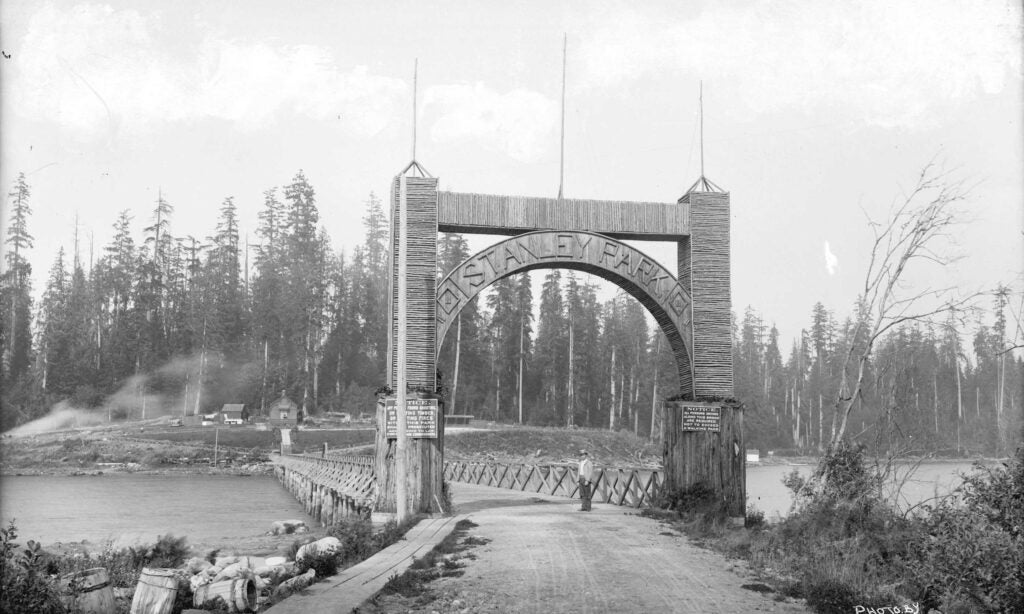
Arch at the entrance to Stanley Park in the 1890s. (City of Vancouver Archives, AM54-S4-: St Pk P79, Harry Devine)
If you’re visiting Vancouver, one place almost everyone will tell you not to miss is Stanley Park, a sprawling urban park known for its scenic views, iconic seawall and cultural landmarks. This 405-hectare urban park, located at the northwestern tip of Vancouver’s downtown, provides not only recreational opportunities but also breathtaking views. The iconic road around the peninsula loops past the Vancouver Aquarium, Brockton Point, the Nine O’Clock Gun, Lost Lagoon and public beaches.
Stanley Park was created during the urban parks movement era in North America — when land was set aside for now famous parks such as Central Park in New York City and Golden Gate Park in San Francisco in an effort to create nature retreats for urban residents.
Yet beneath the well-known landscape of Stanley Park lies a history that many visitors, and even locals, are unaware of. This history holds particular importance, specifically to the Indigenous communities that inhabited the area for more than 3,000 years.
Stanley Park opened on September 27, 1888. Named after Frederick Arthur Stanley, Canada’s governor general at the time, it serves as a place for locals and tourists to enjoy the natural scenery of beaches and coniferous forests. Although it is currently under the jurisdiction of the Vancouver Board of Parks and Recreation, the land on which it sits is unceded, belonging to the xʷməθkʷəy̓əm (Musqueam), Sḵwx̱wú7mesh (Squamish) and səlilwətaɬ (Tsleil-Waututh) peoples. To make room for the park’s development, many communities of Indigenous and mixed descent were violently displaced without compensation. The current Lumberman’s Arch was once home to one of the largest Indigenous settlements in the Lower Mainland, X̱wáýx̱way (English phonetic spelling: Whoi Whoi). The community’s removal ultimately resulted in not only the loss of their living places, but also the valuable resources drawn from the marine and forest ecosystems that sustained their families.
To make room for the park’s development, many communities of Indigenous and mixed descent were violently displaced without compensation.
Evictions were also carried out after the park opened. In 1925, the Supreme Court of Canada decided several cases against the remaining residents at Brockton Point, leading to the last of the Indigenous residents being forced out of their homes throughout the 1930s. An exception was given to Tim and Agnes Cummings, siblings who stayed in their home until their deaths in the 1950s.
Along with the ongoing evictions in the 1920s and 1930s, the government erected four totem poles near Lumberman’s Arch. These were placed there as part of a broader plan to recreate a Kwakwaka’wakw village, generating an apparent paradox in which Indigenous culture was simultaneously being erased and highlighted. More poles were transported to the park in the 1930s before being moved to their current location near Brockton Point in the 1960s. Moreover, these totem poles were brought from the Kwakiutl, Haida, Nisga’a and Nuu-chah-nulth Nations — not associated with the land on which they stand. This further exemplifies the ways in which Indigenous history has been misconstrued.
As historian Jean Barman stated, “The Squamish presence at Whoi Whoi [X̱wáýx̱way] and Brockton Point was overlaid with the material culture of a wholly different people who lived a safe distance from Vancouver.”
The history of Stanley Park presents a social dimension to our work on shifting baseline syndrome. Since the evictions took place, successive generations of settlers have become accustomed to a landscape with limited Indigenous identity. This erasure of indigeneity happened early enough that many people today do not have any memory of it, quietly resetting the baseline to one of a social environment without the influence of the Musqueam, Squamish and Tsleil-Waututh Nations.
This erasure of indigeneity happened early enough that many people today do not have any memory of it, quietly resetting the baseline to one of a social environment without the influence of the Musqueam, Squamish and Tsleil-Waututh Nations.
Understanding the history of an area, including its Indigenous history, is a critical step to upholding the rights of Indigenous Peoples. Indigenous knowledge can provide historical baselines through lived experiences, not only about pre-colonial environmental conditions but about identity. This vital connection to different histories reminds us that what we see today is not what has always been.
Written in consultation with the X̱wi7x̱wa library.
Guest authors: Mackenzie Roberts, Sanjum Dhillon, Tony Wei, Luna Yu, Brandon Wei
Our work
Always grounded in sound evidence, the David Suzuki Foundation empowers people to take action in their communities on the environmental challenges we collectively face.