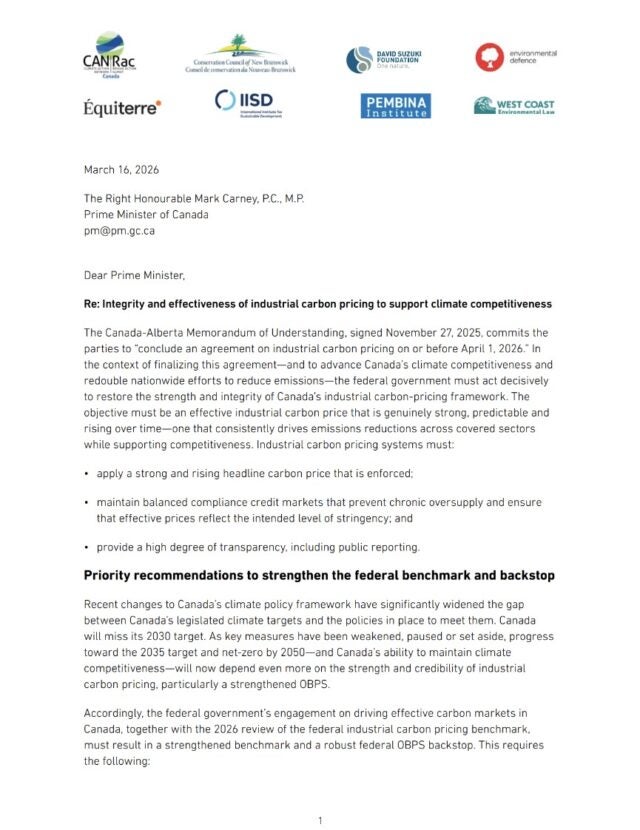
Joint letter to Prime Minister Mark Carney: Restore the integrity and effectiveness of Canada’s industrial carbon pricing framework to support climate competitiveness
Published by:
David Suzuki Foundation and partners
Authored by:
Pierre Iachetti,
Tim Gray,
Beverly Gingras,
Patricia Fuller,
Caroline Brouillette,
Jessica Clogg,
Chris Severson-Baker,
Daniel Rotman
Partners:
Climate Action Network Canada,
Conservation Council of New Brunswick,
Environmental Defence,
Équiterre,
International Institute for Sustainable Development,
Pembina Institute,
West Coast Environmental Law
Climate solutions carbon pricing, climate change, energy, fossil fuels, greenhouse gas emissions, economics, industry, policy and regulation, Climate and biodiversity crises
Leaders of eight major climate organizations are calling on Prime Minister Mark Carney to restore the strength and integrity of Canada’s industrial carbon pricing system to increase competitiveness and reduce greenhouse gas emissions.
This joint letter sent to Prime Minister Carney on March 16, 2026, notes that the federal government has rightly positioned climate competitiveness at the centre of Canada’s economic strategy, and that strategy depends on industrial carbon pricing that is strong, predictable and enforceable in practice. Getting industrial carbon pricing right is among the most consequential economic and climate decisions this government will make. As other federal climate measures have been weakened, paused or outright scrapped, strong, credible industrial carbon pricing systems play an even more decisive role in determining whether Canada can meaningfully reduce industrial emissions and remain competitive in a low-carbon global economy.
Industrial carbon pricing is slated to play a much larger role in Canada’s climate commitments than any other single policy. It is widely agreed to be the most efficient road to industrial decarbonization (in concert with other policies), and for that reason it is key to Canadian industry competitiveness in a world where investors and buyers increasingly care about carbon footprints.