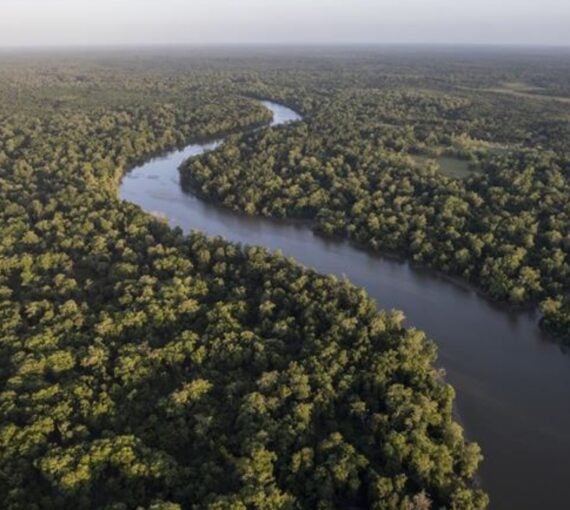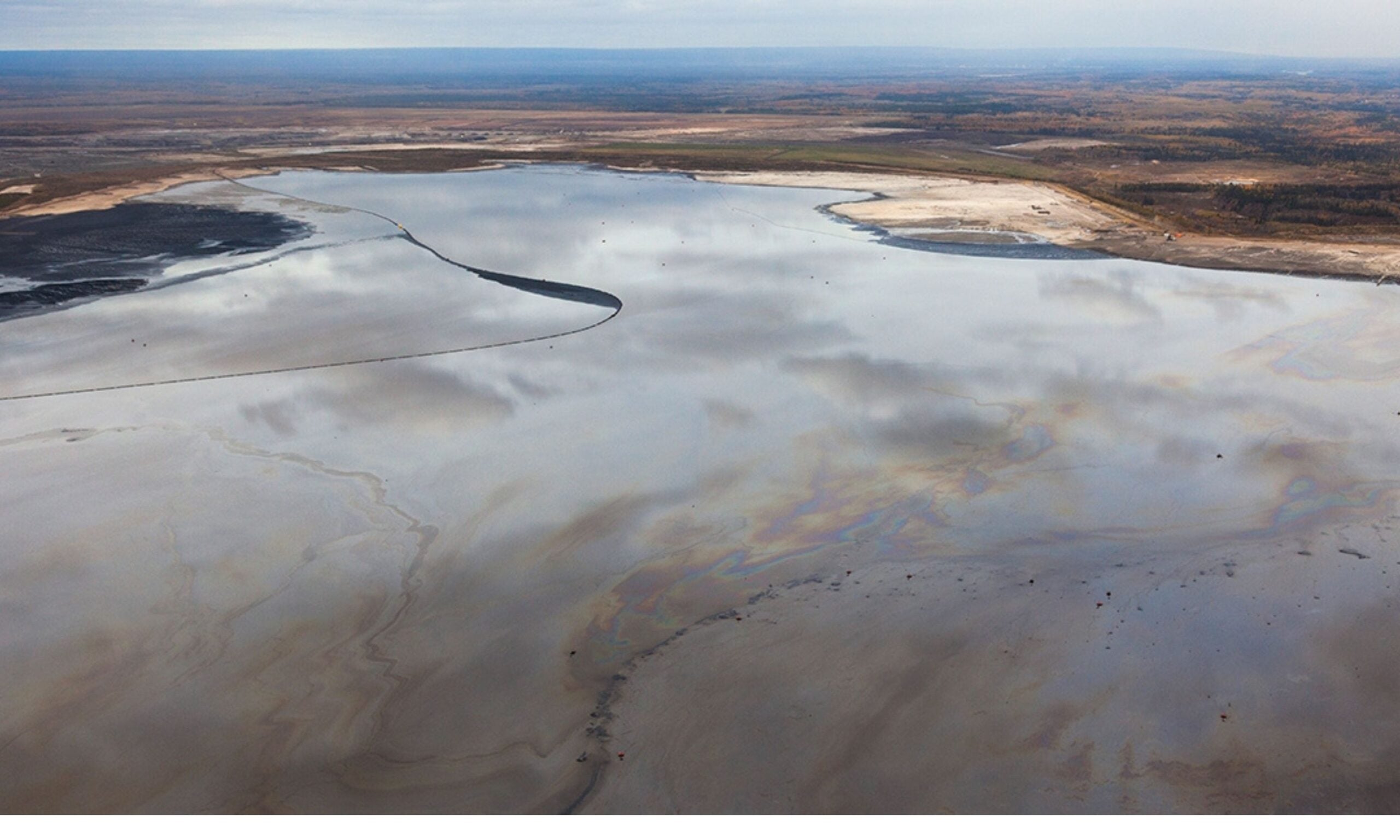
At the World Economic Forum, Mark Carney warned of a new world order of concentrated trade power. After U.S. withdrawal from the Commission for Environmental Cooperation, the environment is paying the price for this kinglike approach to trade governance. (Photo: Alberta Tailings Ponds II via cec.org)
Trade tensions between Canada and the United States were on full display at the January World Economic Forum in Davos, Switzerland.
Prime Minister Mark Carney issued a stark warning on the emerging new world order and hinted at the breakdown of the post–Second World War international community of states, outlining the new reality of countries as fortified enclaves, powerful actors and sovereigns unhinged from the basic tenets of international law and order.
We’re already seeing examples — from a weakened United Nations to rapidly declining multilateralism. Countries are focused on reducing barriers to trade while placing ecosystem and human rights impacts on the back burner.
During his speech, Carney mentioned sustainability as a Canadian value, yet none of the trade deals signed under his purview enhance environmental accountability. Moreover, in the context of the impending review of the Canada-U.S.-Mexico trade agreement, concern is lacking on the extreme environmental deregulation in the United States and its spillover effects into Canada through supply chains and pollution flows. Fortress worlds on Turtle Island exist only in political imagination; on a shared continent of contiguous borders, lands and waters continue to bind states, despite claims of isolation.
What is unfolding is the normalization of a kinglike approach to trade and environmental governance.
What is unfolding is the normalization of a kinglike approach to trade and environmental governance.
The recent U.S. executive order directing withdrawal from a range of international organizations, including the Commission for Environmental Cooperation, has been framed as a routine assertion of presidential authority and went largely unnoticed by the Canadian public. Yet it is a treaty-based institution, first established under the North American Agreement on Environmental Cooperation alongside the North American Free Trade Agreement, and later reaffirmed through the Environmental Cooperation Agreement that accompanies the Canada-U.S.-Mexico trade agreement. Its mandate, structure and procedures flow directly from negotiated international commitments. A president cannot simply withdraw from an institution created by treaty without raising serious constitutional and international law concerns. Unilateral executive withdrawal from a treaty-based institution is both legally contested and deeply destabilizing. The CEC’s most significant contribution is the Submissions on Enforcement Matters process. This mechanism allows civil society actors — communities, public interest organizations and individuals — to file complaints when the U.S., Mexican or Canadian governments fail to effectively enforce their own environmental laws. While this process does not impose sanctions, it creates something equally important for residents across the three countries: an internationally recognized pathway to document harm, compel governmental transparency and produce independent factual records that governments cannot ignore.
Over time, SEM cases have brought international scrutiny to pollution and enforcement failures affecting front-line communities across North America, notably from Alberta oilsands tailings ponds. They have unveiled findings on industrial emissions and other forms of pollution and revealed systemic regulatory failures, as well as environmentally destructive practices from oil and gas development. On a continent with no climate court, no binding international enforcement bodies and ineffective domestic remedies accessible to civil society, the SEM process has functioned as a last-resort accountability mechanism, with real international visibility.
Without U.S. participation, the SEM process, and the CEC itself, risks becoming hollow. This should deeply concern the Carney government. The Canada-U.S.-Mexico agreement’s environment chapter was already constrained, tying enforcement to trade effects and omitting binding climate commitments altogether. In North America, the SEM process has been one of the few tools capable of piercing the black box of trade governance and exposing environmental harms that are otherwise buried under political compromise.
The public should be concerned. Trade agreements like the one between Canada, the U.S. and Mexico are negotiated behind closed doors, finalized through opaque political trade-offs and almost entirely insulated from public participation once ratified. Environmental chapters are often presented as safeguards, but they rely entirely on institutions like the CEC to give them real-world effect. When those institutions can be cast aside by presidential executive order, the promise of sustainability in trade becomes impossible to deliver.
There can be no kings in environmental governance. No single executive — whether in Washington, Ottawa or elsewhere — should be able to rewrite the rules of environmental accountability. Yet this is precisely the model being normalized: centralized decision-making, minimal transparency and diminished pathways for the public to challenge environmental regression.
No single executive — whether in Washington, Ottawa or elsewhere — should be able to rewrite the rules of environmental accountability. Yet this is precisely the model being normalized: centralized decision-making, minimal transparency and diminished pathways for the public to challenge environmental regression.
The timing could not be worse. Canada is actively promoting new fossil fuel infrastructure, including a memorandum of understanding with Alberta that advances pipeline development and heightens the risk of oilsands expansion. Even though the environmental and climate consequences of further oilsands growth are well documented, domestic regulatory frameworks have repeatedly failed to meaningfully constrain their expansion. At the international level, the SEM process remains one of the only mechanisms capable of subjecting these impacts to independent scrutiny.
Mexico, too, stands to lose without a strong commitment against environmental backsliding. Communities facing air pollution, water contamination and weak enforcement of environmental laws are already constrained by limited or inaccessible domestic remedies. The SEM process has provided a way to elevate these concerns beyond national borders and into an international forum that recognizes them as matters of public interest.
The U.S. executive order does more than withdraw from an institution; it exposes the weakness of the Canada-U.S.-Mexico agreement’s environmental promises and the fragility of environmental cooperation in North America. Allowing the CEC to be dismantled through executive fiat entrenches a system in which trade has kings, the environment has none and affected communities are left without recourse.
If environmental protection on Turtle Island is to mean anything in this new world order, people across the three countries must resist the normalization of secrecy, unilateralism and executive dominance at home and abroad, and insist that environmental governance remains grounded in law, transparency and public participation.